
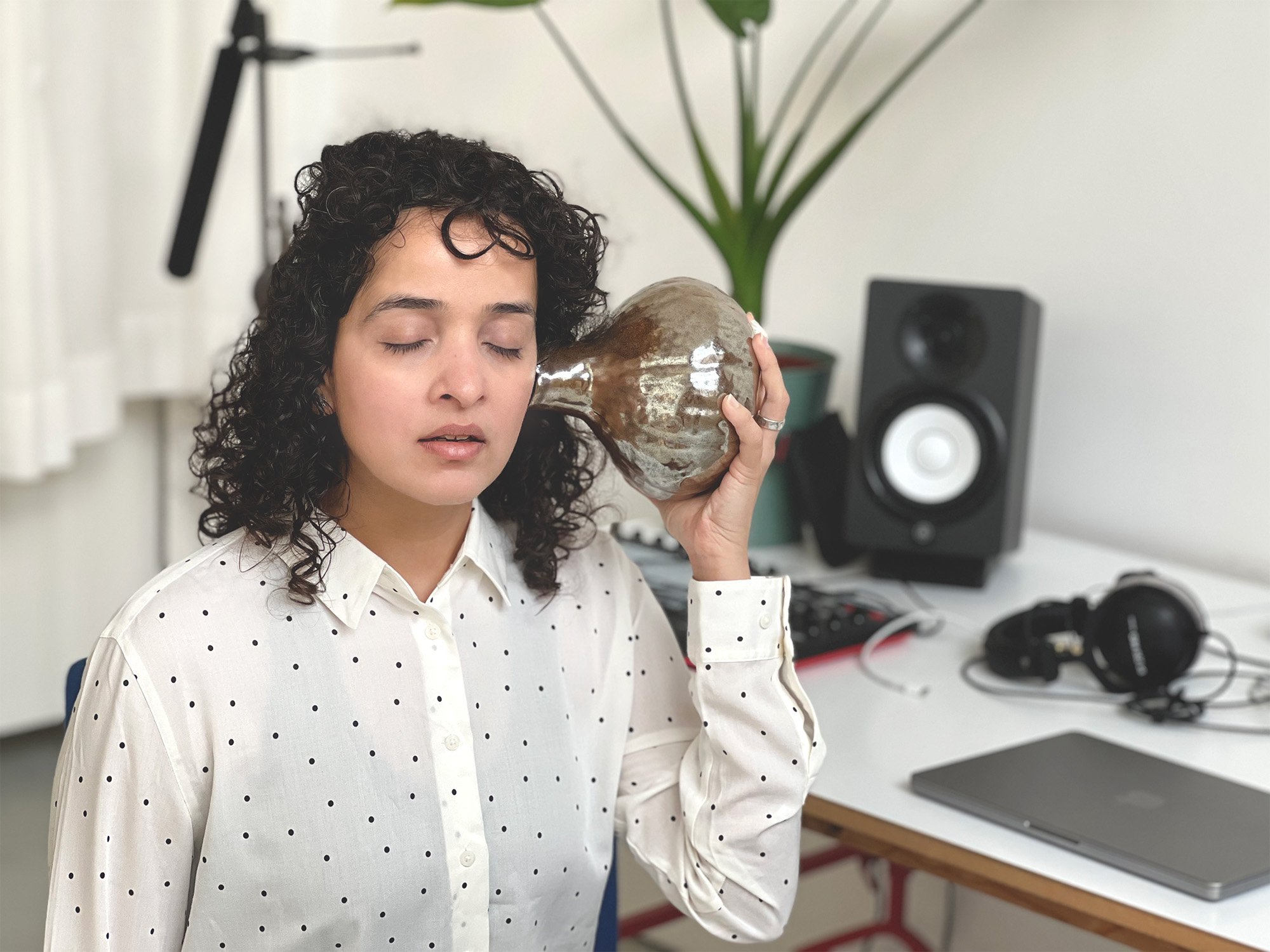
Alifiyah Imani
Artist and writer whose multidisciplinary practice locates sound as a lived and relational process.
Alifiyah Imani is spotlighted in the New Voices series, which highlights emerging artists who showcase their art on ArtConnect.
Berlin-based artist and writer Alifiyah Imani is originally from Karachi, Pakistan. In her artistic practice, she interrelates sonic experiences through various new media and forms, working primarily with sound installation, electroacoustic music, and experimental radio. Locating sound as lived and relational process, she explores the nuances of drones, harmonics, and overtone colourations in different instruments and voice, using these sonic nuances as compositional structures in her work.
Increasingly, her work is focused on expanded instrument design, drawing inspiration from historical instruments, craft making processes and contemporary experiments in physical sound as a form of sculptural assemblage. Mesmerising drones act as carriers of these processes, bringing the sound into circulation. Within these material and immaterial landscapes, her practice emphasises the relationship between form and ritual, modes of translation, tuning, and transduction as they unfold across spatial and performative configurations.
Curious to gain more insight into her artistic approach, we asked Alifiyah a few questions about her practice.

an entropy of one’s own, Dystopia Sound Art Biennial, Berlin, 2024 © Alifiyah Imani
What initially sparked your interest in working with sound?
I was creating long-form pieces for radio and began treating the medium as an extended field where I could explore listening practices with people, with instruments, and ways of sonic ritual making with myself. Radio carries its own kind of wild freedom and quiet intimacy given the way it travels and reaches listeners.
But perhaps a deeper spark came when I joined a singing circle and discovered overtone singing. This technique of singing opened a new dimension of sound for me, a subtle architecture I could feel as much as hear. It taught me to listen more closely, to pay attention to the hidden structures, the DNA and microscopic signatures inside a tone and greatly influenced the way I started viewing and recording instruments, and working with them.
A language began to form that felt personal to me. It felt as if I had discovered a new listening consciousness of sound and its microtonal nuances. Soon I was exploring this dimension of overtones with a small collection of acoustic instruments. One of them is the ancient drone instrument, Tanpura, central to South Asian music which has been the primary inspiration for my practice over several years. Its unique and unforgettable sound entered my process, especially in what it taught me about tuning, since the instrument itself is essentially a guide for tuning. At its core, I’m drawn to the cyclic inner life of a sustained sound and what you start hearing in its continuity.
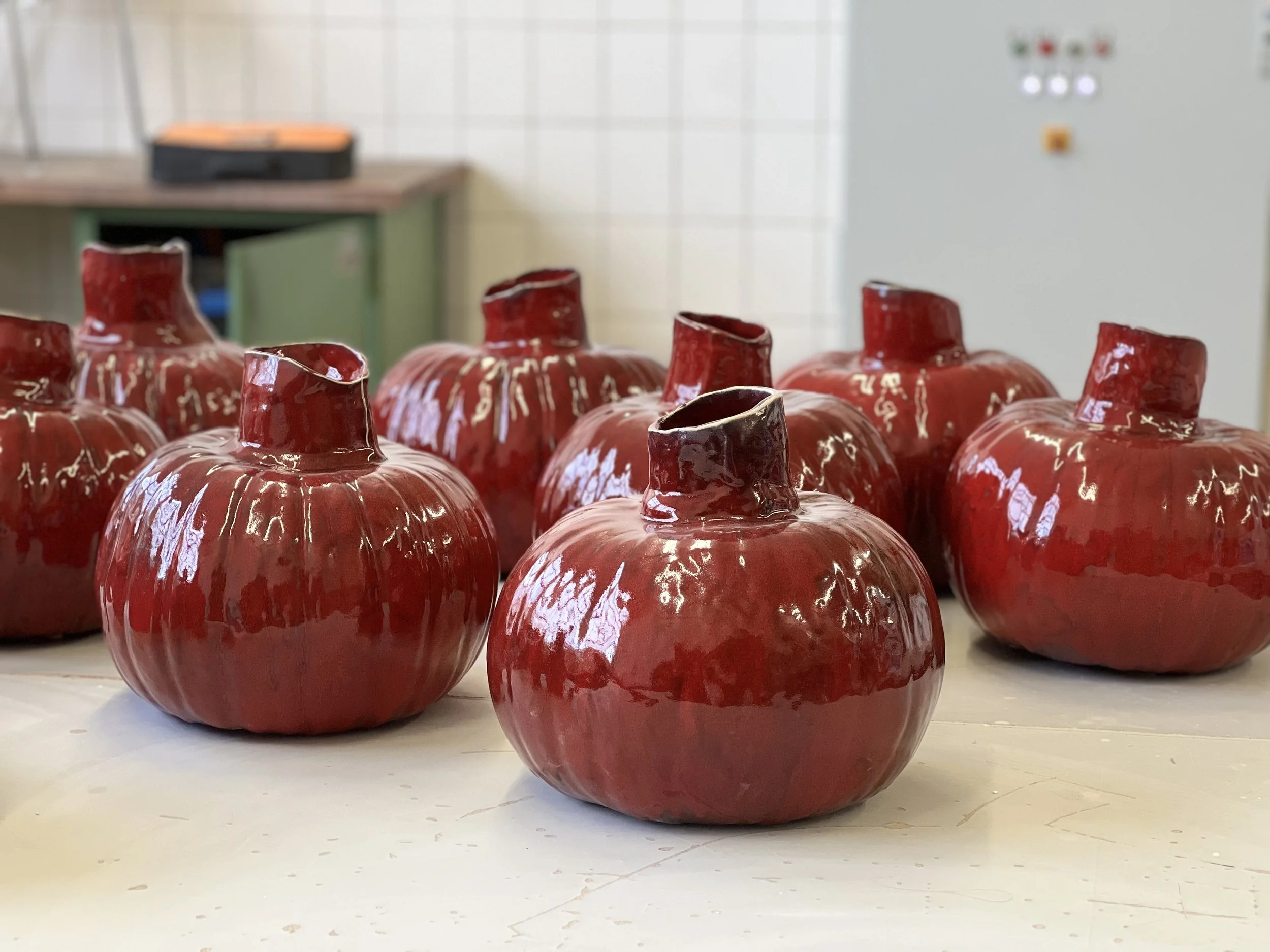
Studio process at HBK Braunschweig © Alifiyah Imani

Your practice interrelates sonic experiences through new media and forms. How has your use of different mediums evolved over time?
This year I’ve been exploring ceramics intensely, a medium that teaches through doing, through repetition, and through attentive listening to the material itself. I am curious about the metaphysics of materials that can transform, where both form and emptiness can coexist together and become the conditions for sound to exist. I also like that working with clay exists outside of the mind, it demands a certain physicality, patience, presence, and responsiveness. You’re constantly making and testing processes.
The meeting point of ceramics and contemporary sound practice is what I’ve been investigating; two modes that require different kinds of calibration. In many ways I’m building an instrument with this in mind where the slow, embodied, and tactile process of working with clay intersects the precise processes of shaping a sound. And because ceramics is still new to me, I’m also learning the slow accumulation of technique, the discipline of craft, and the long detailed processes that you can’t control or fully will.
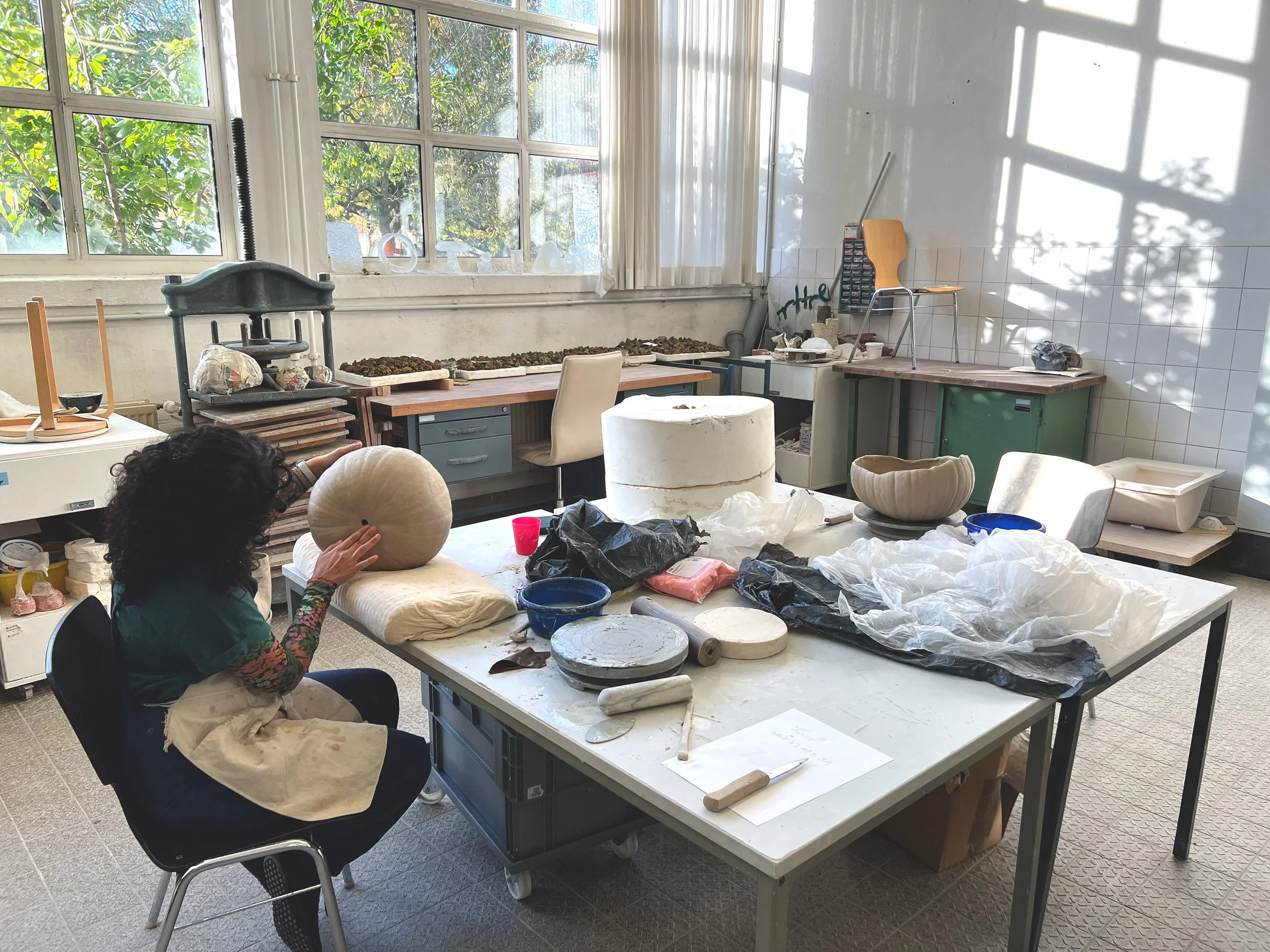
Studio process at HBK Braunschweig © Alifiyah Imani
Through your practice, you locate sound as a lived and relational process. Can you expand on how this manifests in your work?
I find that much of experimental practice in the contemporary art world tends to be rooted in a kind of theory and pure conceptuality that I’ve dealt with but find disillusioning as it can give the false impression that we’ve come further than we have. These saturated frameworks often reproduce institutional expectations, internalising the language of funding, academia, and circulating discourses which can make the work seem resolved while the actual practice is still in flux. What has come up for me is that I’ve been questioning and gently decentring myself from the speed and pressure that these overloaded frameworks impose.
Instead, I pay close attention to locating daily practices and pedagogic traditions that may not directly influence my ability to produce art, yet they are transmitted to me by way of teaching, and learning. They carry forms of cultural memory and knowledge, yet what they carry for me isn’t limited to enacting or sustaining cultural identity alone. These are often modest, slow, relational processes, and harder to categorise—ways that accumulate meaning over time.
For me, sound becomes situated inside these temporalities and within these poetics of relation. It is through the everyday experience of negotiating the gap between yourself and the thing you are in relation with, and the complexity of finding language for that exchange.
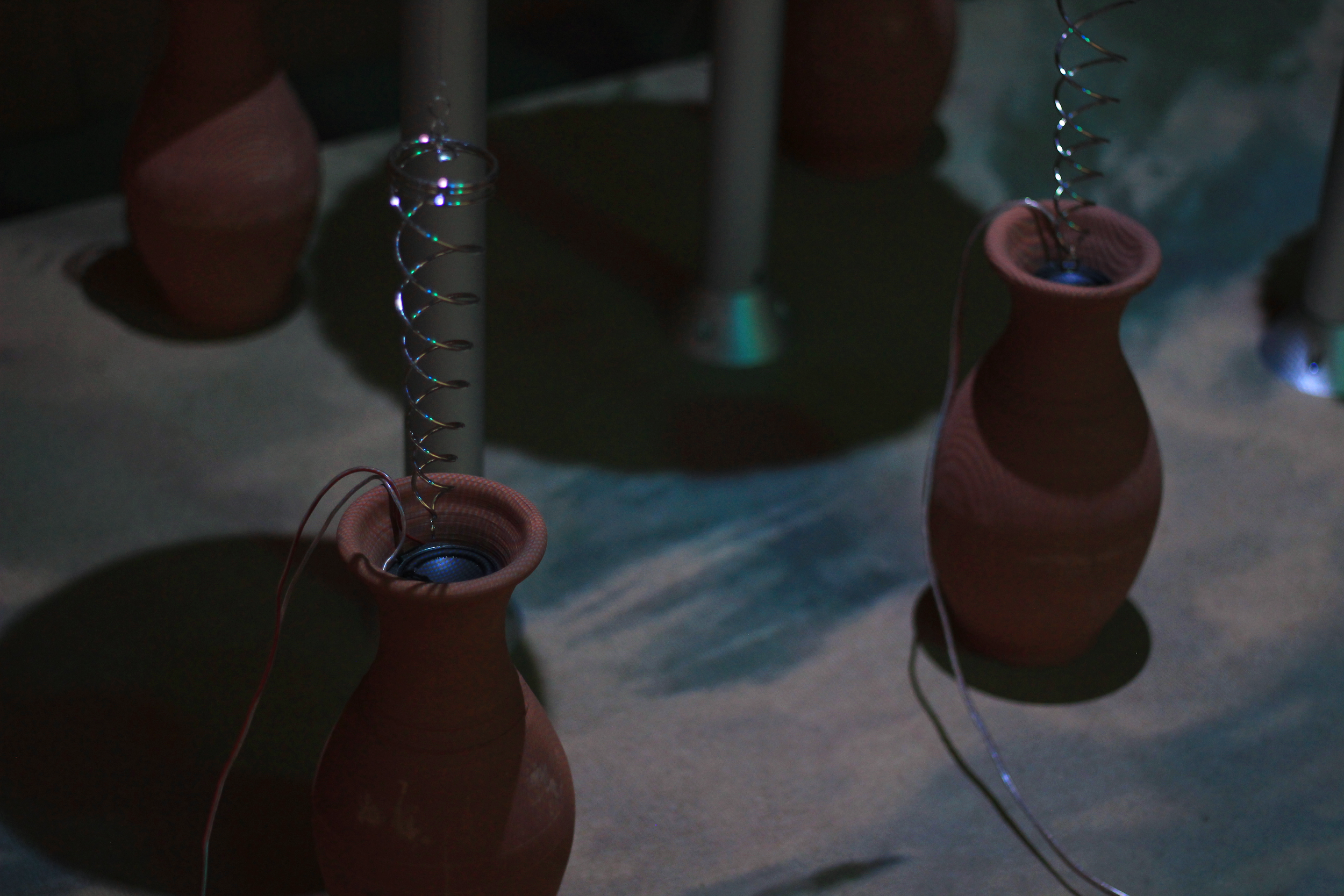
an entropy of one’s own, Dystopia Sound Art Biennial, Berlin, 2024 © Alifiyah Imani
Your approach to listening has been influenced by Rasa aesthetics of Bharatanatyam and Raga-based Dhrupad music. Can you tell us more about these ancient art forms and how they’ve shaped your listening practice?
At some point I realised that through cultural transmission, one creates a concept of sound and music that is inherited, our ear is essentially tuned by the aesthetics, values, and listening traditions we grow up inside. I felt a need to return to this inheritance and understand it alongside my artistic practice. This became especially important when I moved to Berlin in 2021 following several years of precarious post-Masters movement through Europe. I was surrounded by Western technology-focused art environments, avant-garde discourses, and contemporary music frameworks. Amidst these circles, I had reached a kind of rupture and felt unsettled.
I found myself looking for something older, more rooted and this made me attentive to other lineages of listening, particularly within South Asian music and dance, which I hadn’t fully entered into. Studying practices like Bharatanatyam and Dhrupad, I encountered an immediacy—a relational, embodied orality that shifted how I approached sound. When I began training in Bharatanatyam, a classical South Indian dance form, I was initially looking to improve my sense of rhythm musically, but it quickly became something far more expansive. I am pursuing a foundational training that builds your ability to beat out intricate counter-rhythms with the feet, maintain a deep grounded stance, and coordinate hands, neck, and shoulders with precision. It is a form that demands years of training. But beyond its technical rigour, the practice is fundamentally embodied and devotional. It unfolds within an oral lineage where emotion, gesture, breath, and rhythm form a continuous field of expression. This way of training has influenced my listening and understanding of artistic practice as something lived and felt.
Around the same time I began taking voice lessons in Dhrupad. I’ve always been very curious about singing as it's such an invigorating practice. Dhrupad, in particular, is one of the oldest forms of drone-based vocal traditions, carrying the core structures from which many other classical and folk styles of music in the Indian subcontinent have originated. As an art form, Dhrupad treats sound as something alive, imbued with emotion, cosmology, and the charge of presence. It has been an opening for me. Both Bharatnatyam and Dhrupad come from ideologies of listening and presence training that are rarely centred in contemporary sound discourse. I find in them a place of safety and clarity, a space of learning and unlearning. Their long, disciplined timelines counter the accelerated pace of art production. When I feel lost in the purpose of art or depleted in my process, these traditions return energy to me.
You are currently a fellow at Braunschweig Projects. What have you been working on this past year, and how has this experience influenced your practice?
During the residency, I’m taking time to produce a new work and I’ve realised how much time is actually needed if I am to work with ceramics in any meaningful way. I’m mainly using the period of the residency to build an instrument, thinking through craft-making traditions surrounding instrument construction, and ways to interpret them for my practice.
The research process I am exploring deals with historical ways of making instruments and parts that form an instrument’s body, and what signature resonances do they carry. I’ve been drawing on certain South Asian instruments, especially the ektara, tanpura, sitar, and the Rudra veena—which come from deep lineages of heritage, labour, and tacit knowledge. The histories of these instruments, with skills passed quietly from generations of makers have been guides for research and experimentation. I am particularly fascinated by recurring forms—rounded hollow bodies, gourds, and natural enclosures—shapes that seem inherited in the organic logic of how materials naturally grow and create space for sound to resonate.
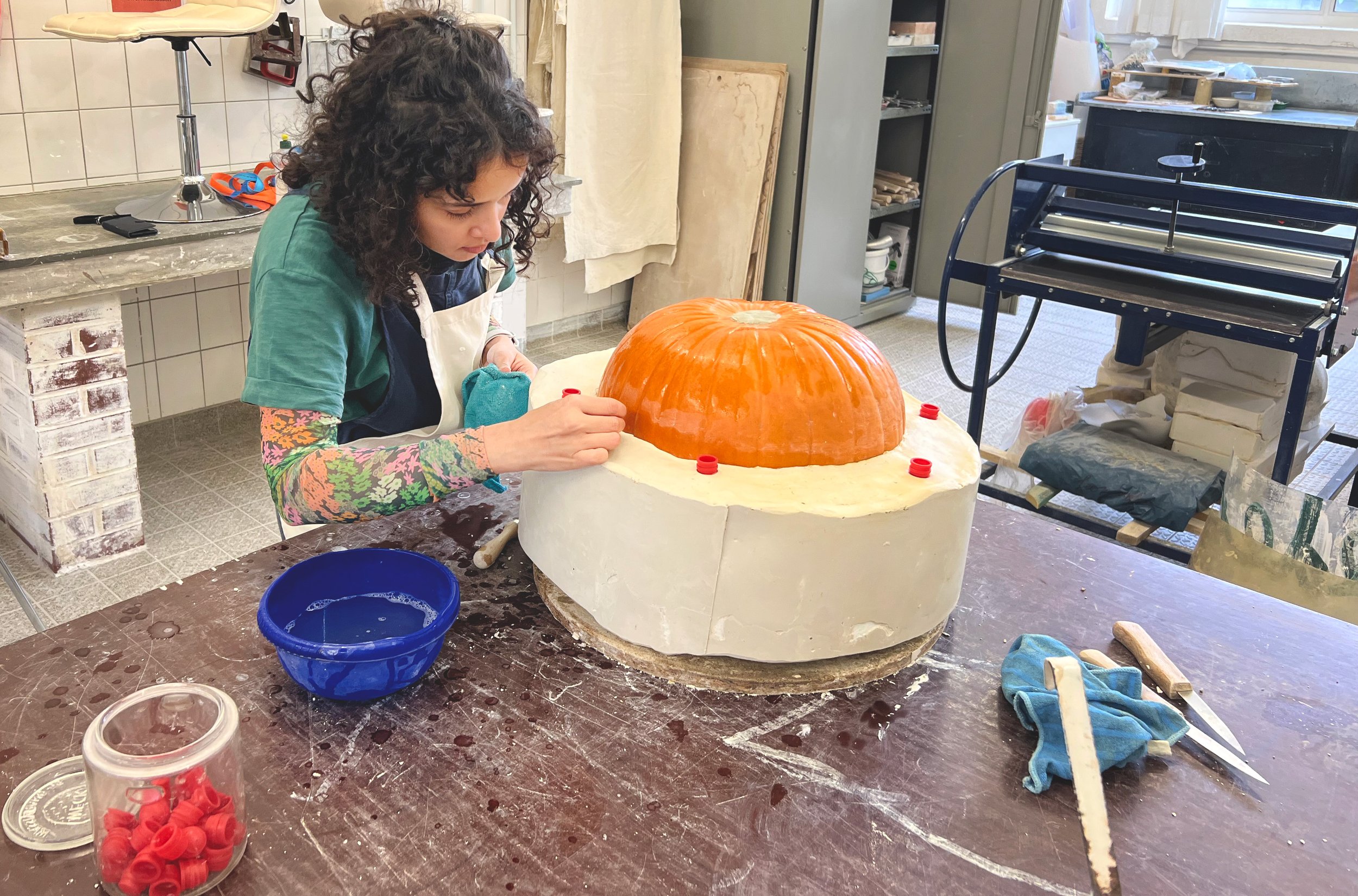
Studio process at HBK Braunschweig © Alifiyah Imani
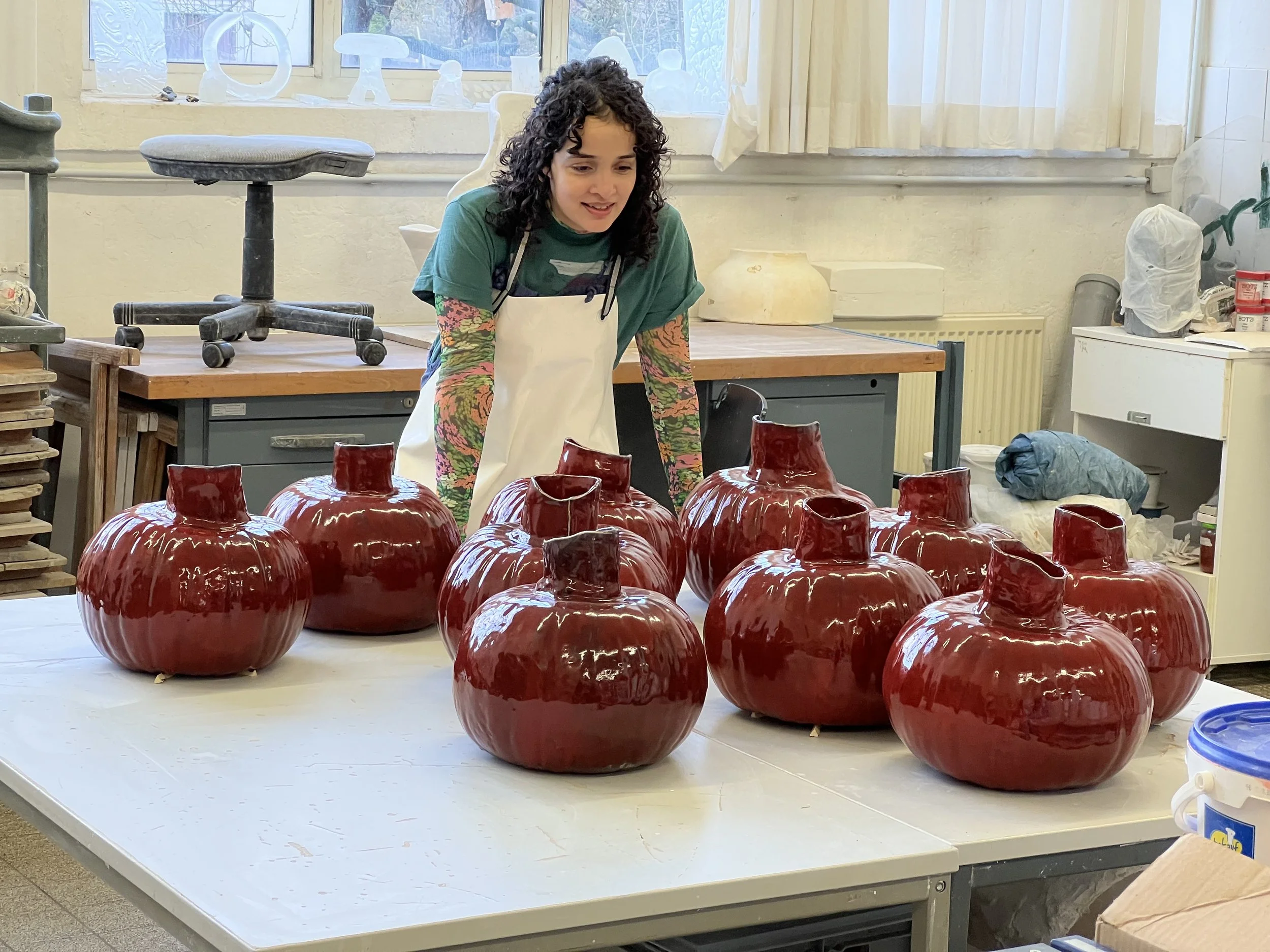
The form of the dried gourd (the tumba) is my main inspiration for the instrument I’m building. Dried gourd is used as a resonating body in traditional folk and classical instruments from South Asia and Africa. I am responding to the way these gourds are prepared and crafted. Using a pumpkin as a reference which closely resembles a gourd, I have transposed its form into clay, a naturally resonant material.
“It is not so much a technical pursuit for me as it is a craft. A sustained engagement with sound, form, the gestures of making, and the alchemy of natural materials.”
The process is long and slow. A gourd is also earth shaped over time, an organic vessel that becomes a container for sound. With ceramics, you are also literally working with the earth and it has its own temporality. I have to work patiently, fine-tuning the shape and thickness through testing different clays, firing methods, and glazing experiments. It is not so much a technical pursuit for me as it is a craft. A sustained engagement with sound, form, the gestures of making, and the alchemy of natural materials.
See more of Alifiyah Imani’s work
New Voices highlights emerging artists who showcase their unique perspectives and innovative techniques on ArtConnect. Applications are accepted on a rolling basis. If you would like to be featured in a personal interview on ArtConnect Magazine, read through the open call and apply here.