
Giulia Vaccaro
On bridging sensation, intuition, and computation
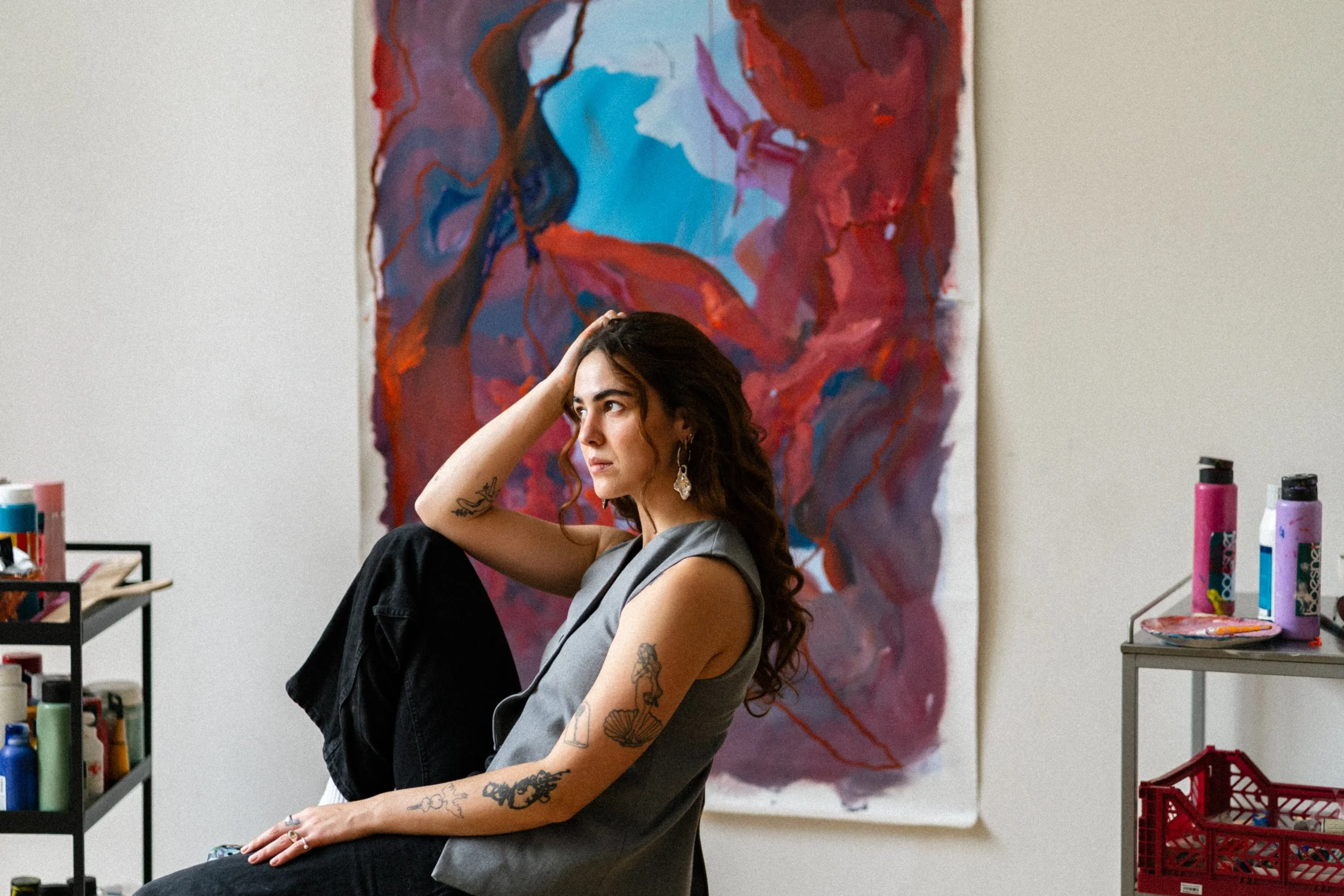
Image: Paula Gierhardt
Giulia Vaccaro is spotlighted in the New Voices series, which highlights emerging artists who showcase their art on ArtConnect.
Berlin-based artist Giulia Vaccaro works across painting, installation, custom-built electronics, and software-based systems. Her practice explores fragility, emotional exposure, and the translation of inner states into technical and material processes. Through time-based and interactive works that slowly shift, destabilize, or erode, she investigates how presence, intimacy, and perception are mediated through digital technologies. Combining handcrafted surfaces with intentionally fragile computational systems, Giulia’s installations question ideas of aura, control, and reproduction in technological environments, allowing error, memory, and failure to become integral elements of the work.
Curious to gain more insight into their artistic approach, we asked Giulia a few questions about her practice.
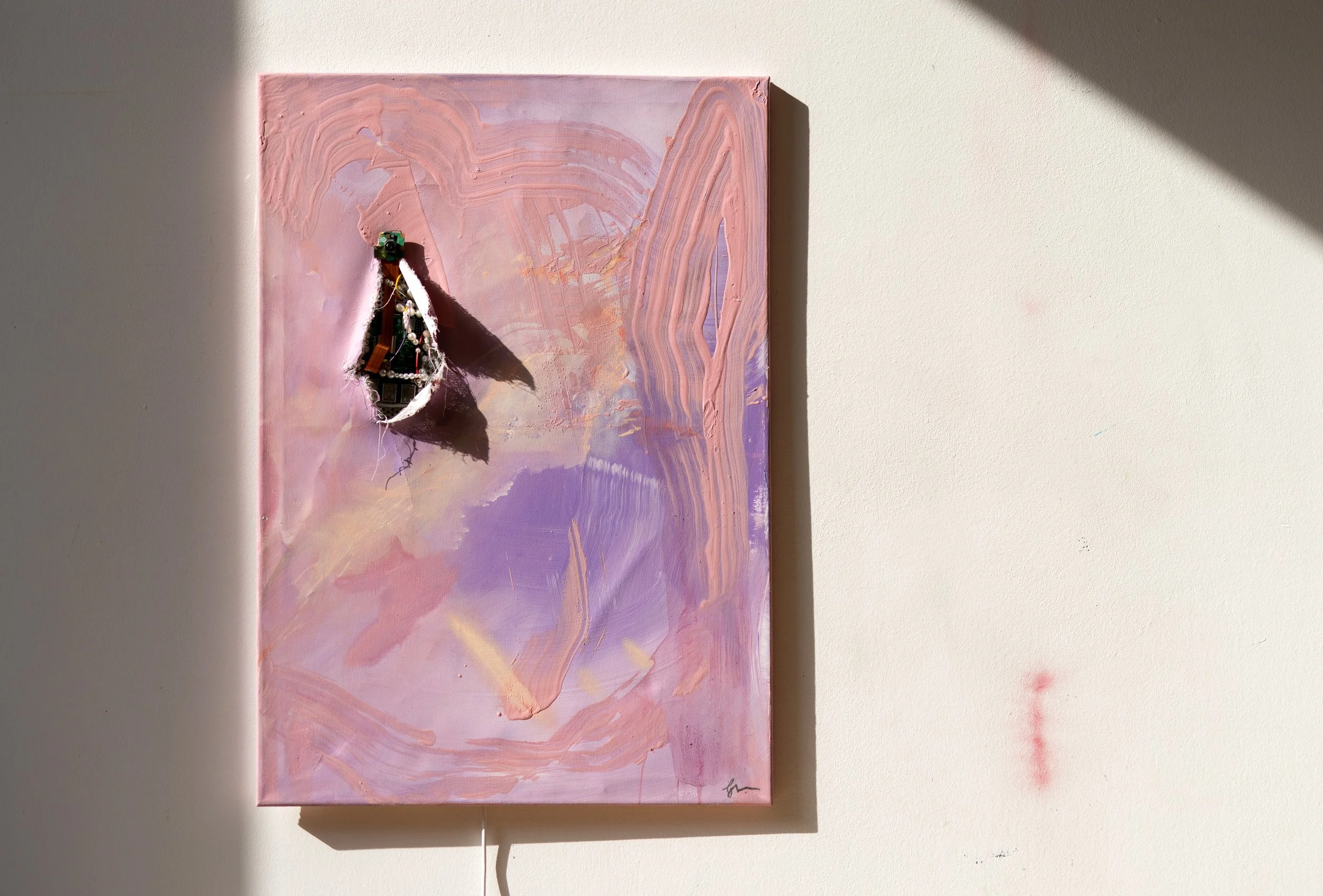
SEEYOUSEEME, 2026. Image: Juliane Flöting
Your artistic process often incorporates layering and reworking. How does a painting evolve from an initial idea into a finished work?
For me, painting never begins with a clear image; it always begins with a feeling. When I paint from that instinctive place, the work tends to become stronger and, most importantly: more honest.
Colour becomes a kind of vocabulary - an attempt to sketch emotional states that are often difficult to articulate in language.
More than ten years ago, one of my first mentors described me as an “emotional whirlwind”, I still think that observation shapes how I work. For me, emotions have colours, and colours carry emotional weight. Everything is constantly in motion, and the painting evolves with that movement - through layering, erasing, and reworking - into a conversation that was never held.
Much of the process is about letting go of control and allowing the work to move somewhere unexpected. Something is always lost in translation. The exact emotional state I experienced while painting can never be fully captured, but perhaps that is also the beauty of it: the painting may hold something entirely different, something that connects to a feeling the viewer once had but never managed to name.
Colour, form, and emotion converse in your practice. How does the interplay between these elements unfold within a painting?
If colour is the vocabulary of the painting, form emerges more like the rhythm in which words are spoken. I do not envision a predetermined composition. Instead, colours enter the surface first, carrying emotional weight, and the forms gradually develop through their interaction.
Sometimes colours attract each other, sometimes they resist or interrupt one another. Through this process the painting begins to organise itself spatially and rhythmically. What initially appears as intuition slowly becomes structure - I like to think of this process almost as a conversation unfolding. Colour, form, and gesture constantly respond to each other, shifting the emotional tone of the work. Because emotional states themselves are never static, the painting remains in motion for a long time. Layers accumulate, relationships change, and the image slowly stabilises - or sometimes refuses to stabilise entirely.
“I’m drawn to the moment where colour begins to shift from sensation to information, where something felt becomes structured and almost computational.”
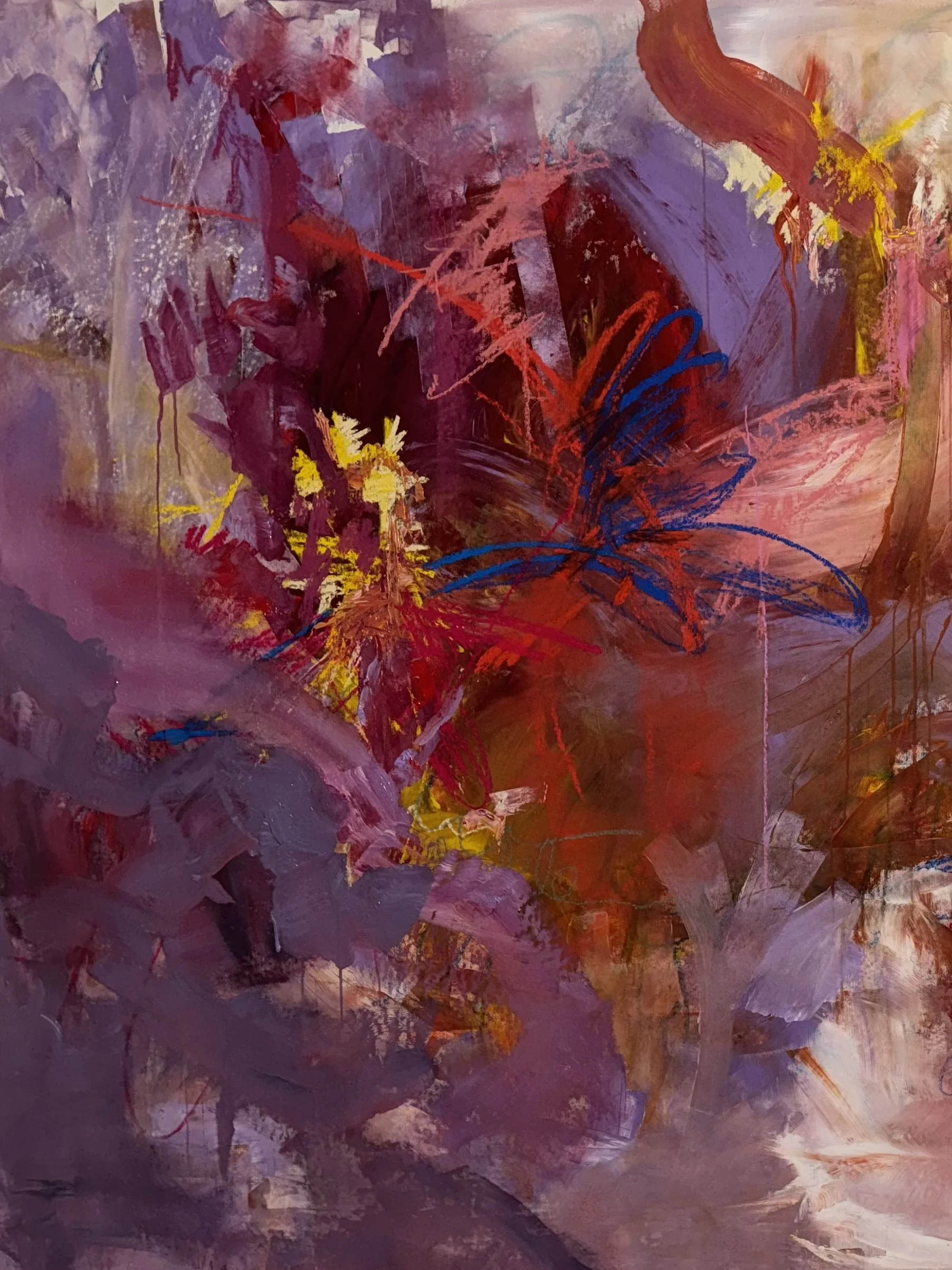
Iraflor, 2024, 150x200 cm, acrylic on canvas.
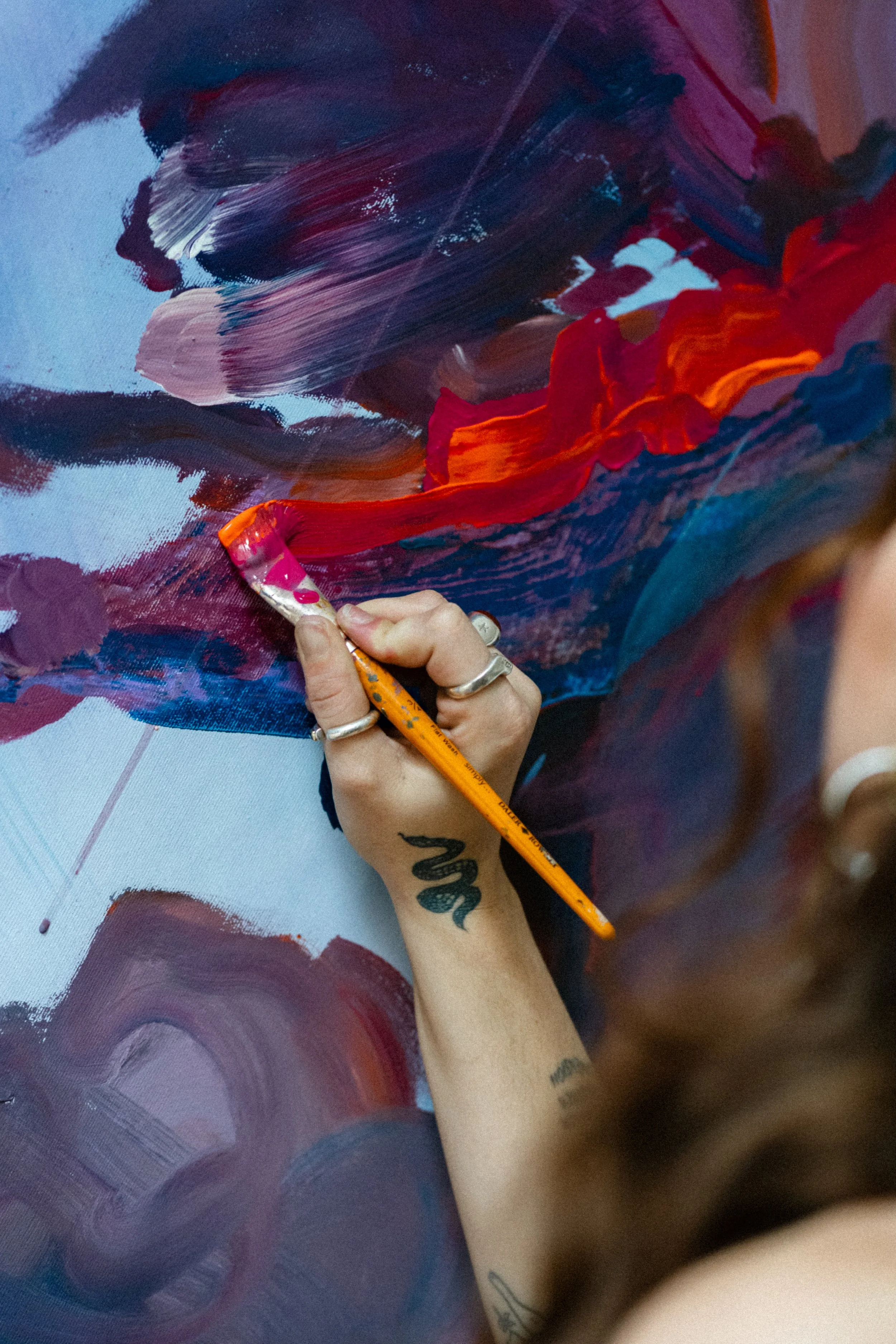
Process Detail. Image: Paula Gierhardt
Your works often feature a vibrant colour palette. How do you approach working with colour?
Colour is deeply embedded in human perception. We constantly read it as emotion, atmosphere, attraction, or warning, often without even noticing. Because of this, colour already functions as a kind of information system long before it appears in digital form.
In my paintings I approach colour intuitively, almost as a direct extension of emotional states. At the same time I’m aware that colour also exists as data - as numerical values, signals, and coded information within technological systems. What interests me is the space between these two conditions: colour is intensely subjective and emotional, yet it also behaves like a system we all quietly understand in a similar way – vocabulary that we can all use without ever actively learning those languages. Understanding colour comes from within ourselves.
In my practice I’m drawn to the moment where colour begins to shift from sensation to information, where something felt becomes structured and almost computational.
More recently, you’ve begun incorporating robotics into your practice. What technologies are you currently experimenting with, and how are they influencing your process as a painter?
Technology has been part of my life for much longer than my artistic practice might suggest. I’ve been working in IT security for over a decade, with many years of experience as a Hacker. For a long time it felt like I was living a kind of double life: on one side technology, on the other side art. Only recently I began to understand that this tension was never really a conflict. It simply meant that I had access to a broader vocabulary.
Painting taught me how to translate emotional states into colour, gesture, and material. Technology, on the other hand, allows me to build systems that can process uncertainty, time, and behaviour. When robotics or computational systems enter the work, they are not replacing my paintings - they are merely expanding my vocabulary.
Instead of the hand alone producing the image, the work becomes a collaboration between human intention, machine processes, and material response.
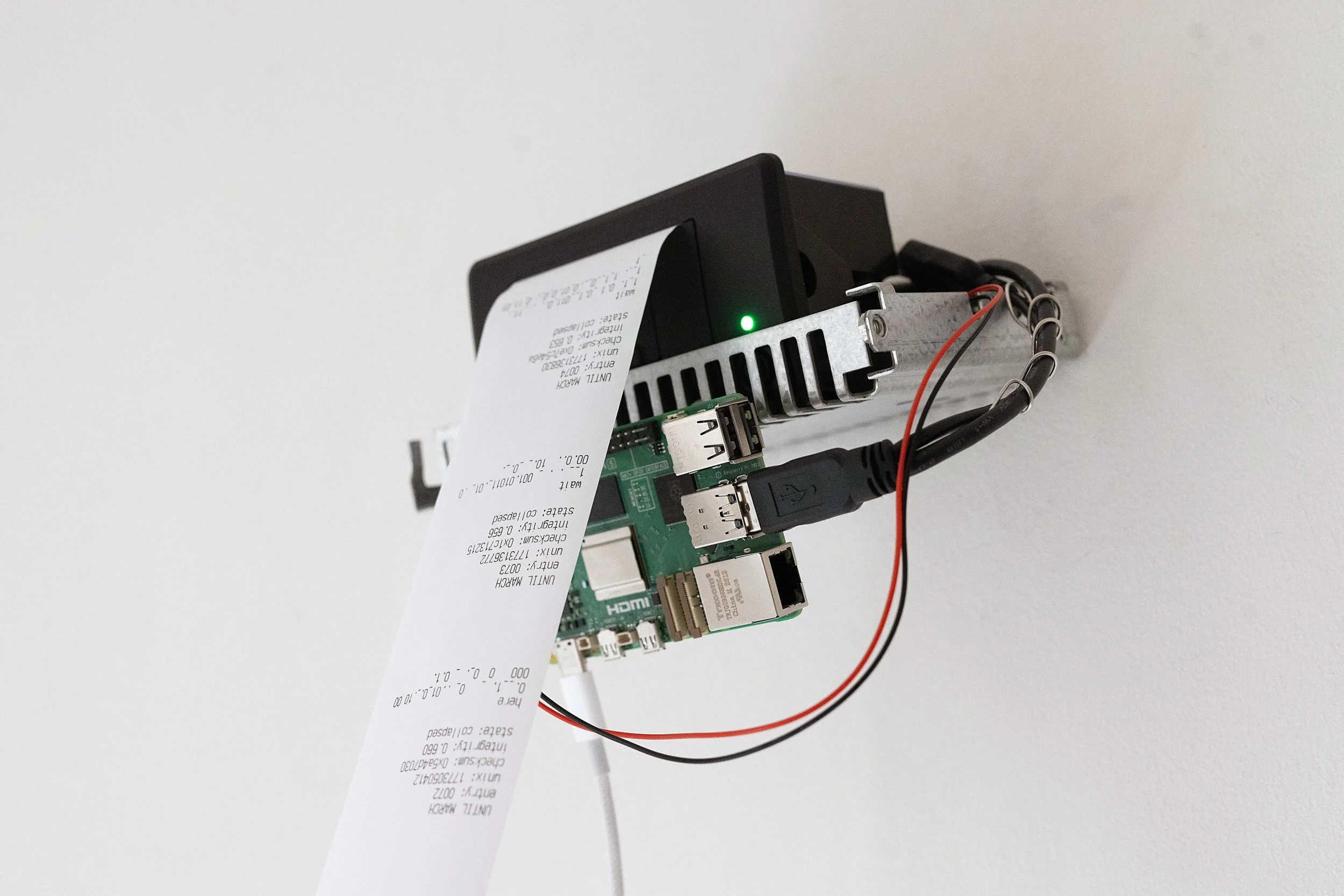
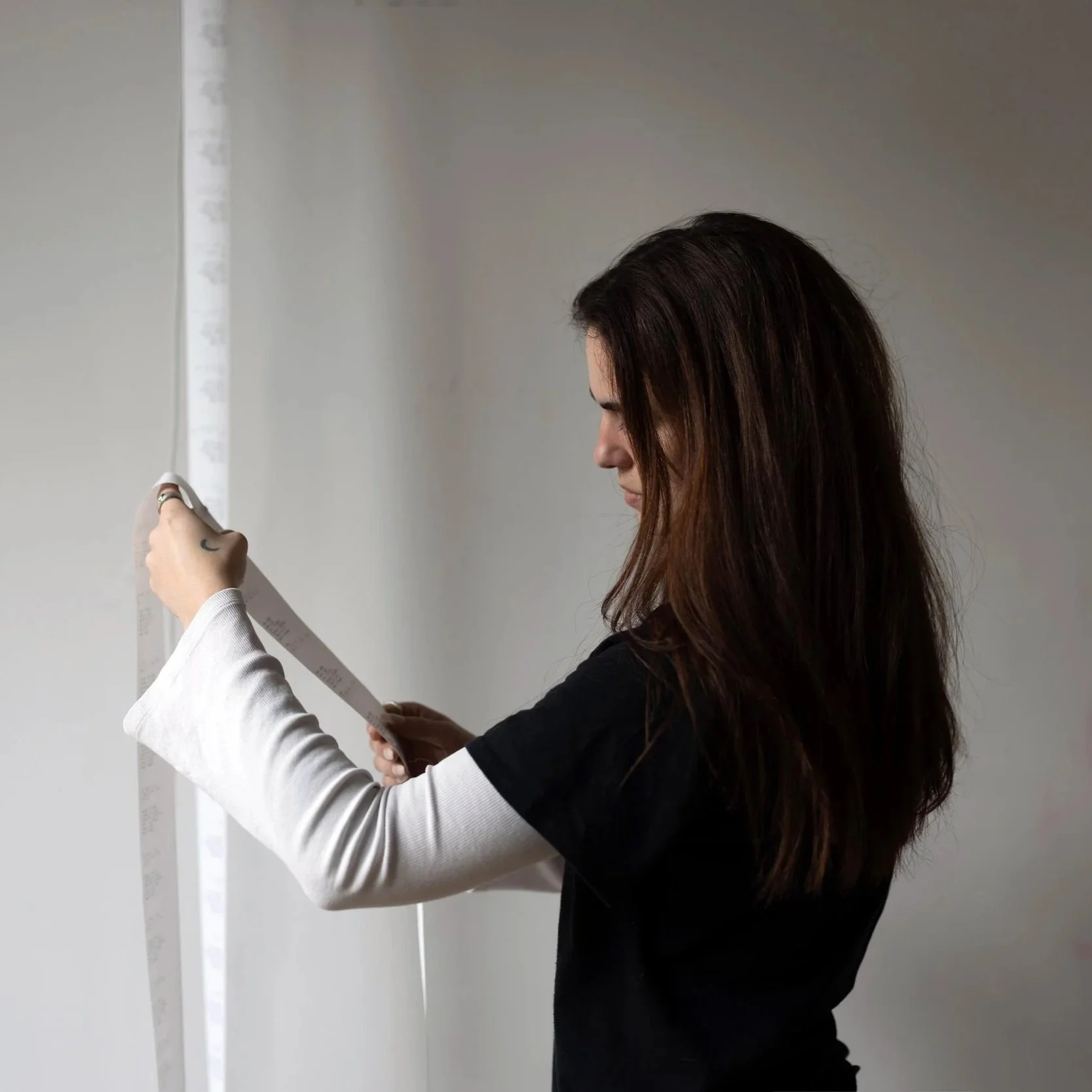
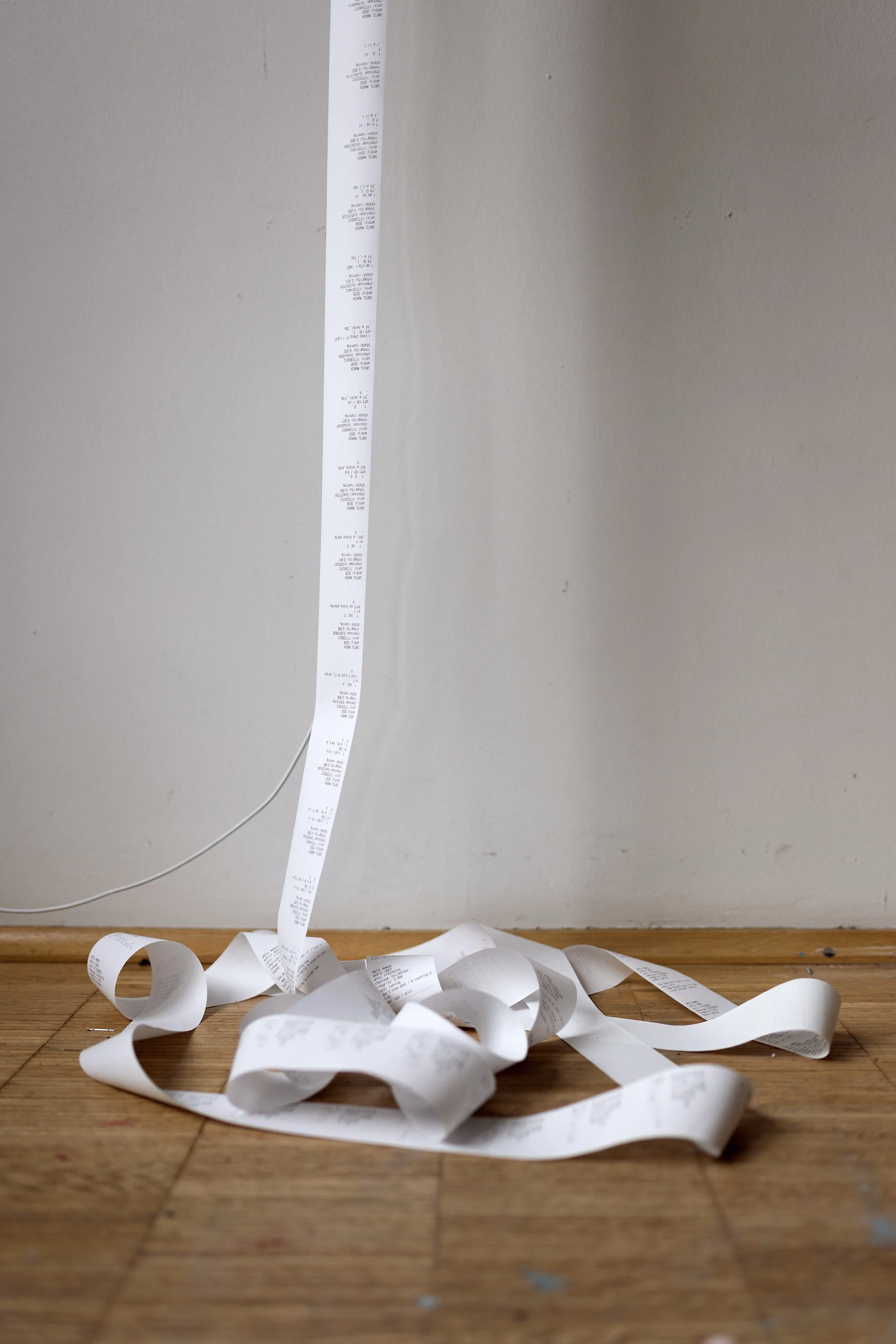
UNTIL MARCH, 2026. Images: Juliane Flöting
“When robotics or computational systems enter the work, they are not replacing my paintings - they are merely expanding my vocabulary.”
A recent work of your UNTIL MARCH is a self-writing system. How does this system operate and what inspired its inception?
UNTIL MARCH is, in many ways, an extension of myself. It emerged from a situation in which I found myself waiting for something that might happen in March. The situation occupied me emotionally, and I began wondering what it actually means to wait.
I realised that anticipation is nothing more than waiting, just dressed up in a pretty gown - while fear is also waiting, just stripped entirely naked. Both are emotional costumes worn by the same underlying condition. Building the system became a way of externalising that state. In a sense, it is a constructed and physical dissociation from a feeling I would rather observe than carry within myself.
The machine writes continuously, generating fragments of text over time, but it also constantly overwrites and erases itself. Rather than accumulating meaning, the work exists in a state of continuous becoming and disappearance. It inhabits the act of waiting itself - moving forward without knowing what will happen next, while gradually dissolving its own traces.
Fragility and instability are central to this piece. What do these qualities represent for you conceptually, and how do they manifest physically in the work?
Fragility is essential to the work because waiting itself is fragile. It is a state defined by uncertainty and a lack of control. If the system were perfectly stable or predictable, it would contradict the emotional condition it is meant to reflect. In UNTIL MARCH, fragility manifests both conceptually and physically. The system continuously produces text, but it also erases and overwrites its own output. What appears on the surface is always temporary. Nothing stabilises for long, and the work never settles into a final form.
I’m generally interested in technological systems that resist the idea of efficiency or permanence. In most contexts, technology is designed to eliminate error and maximise control. In my work, I try to do the opposite: I build systems that allow interruption, failure and instability to become part of their behaviour.
In that sense, fragility is not a malfunction but a deliberate condition - one that mirrors the way human emotional states actually operate - imperfect, honest and raw.
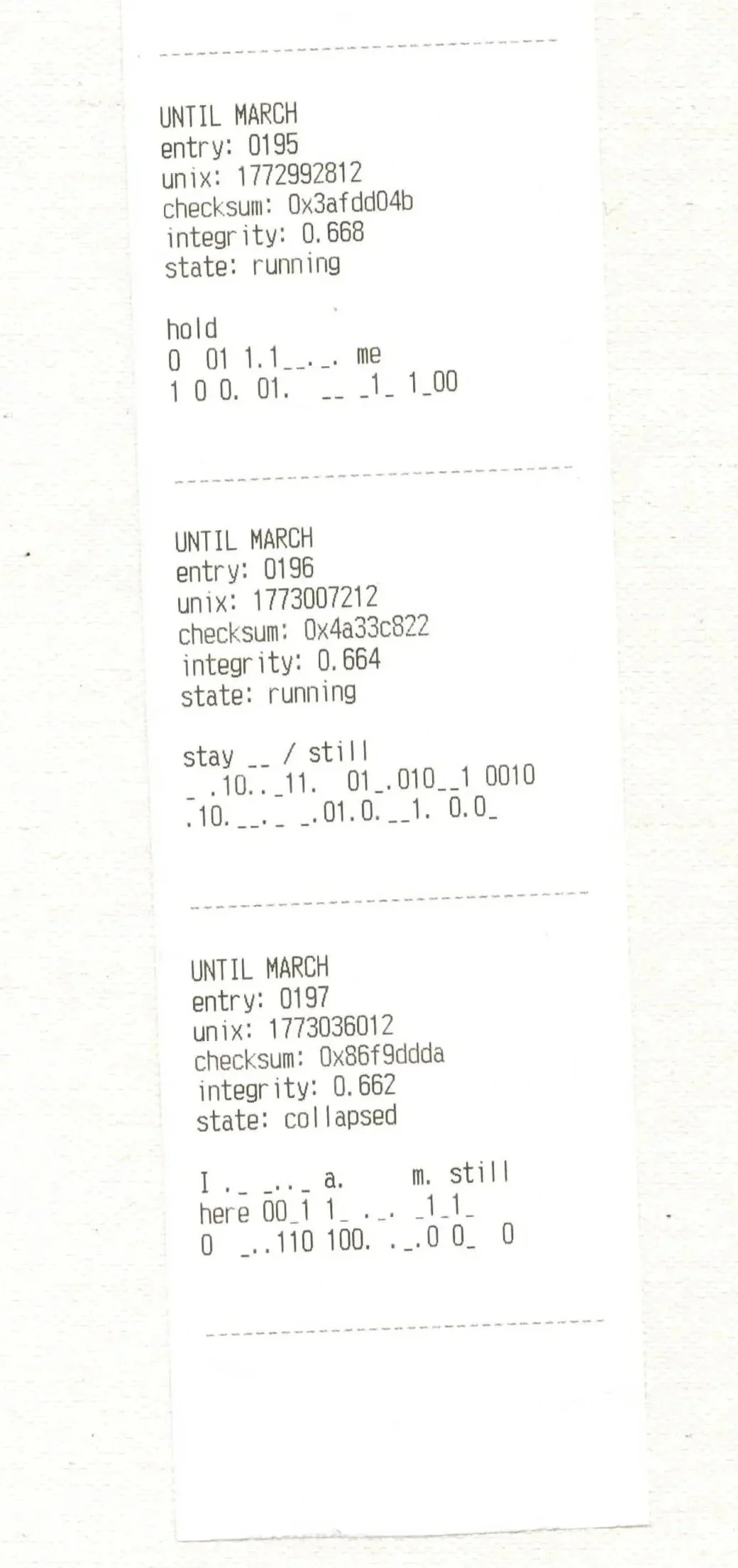
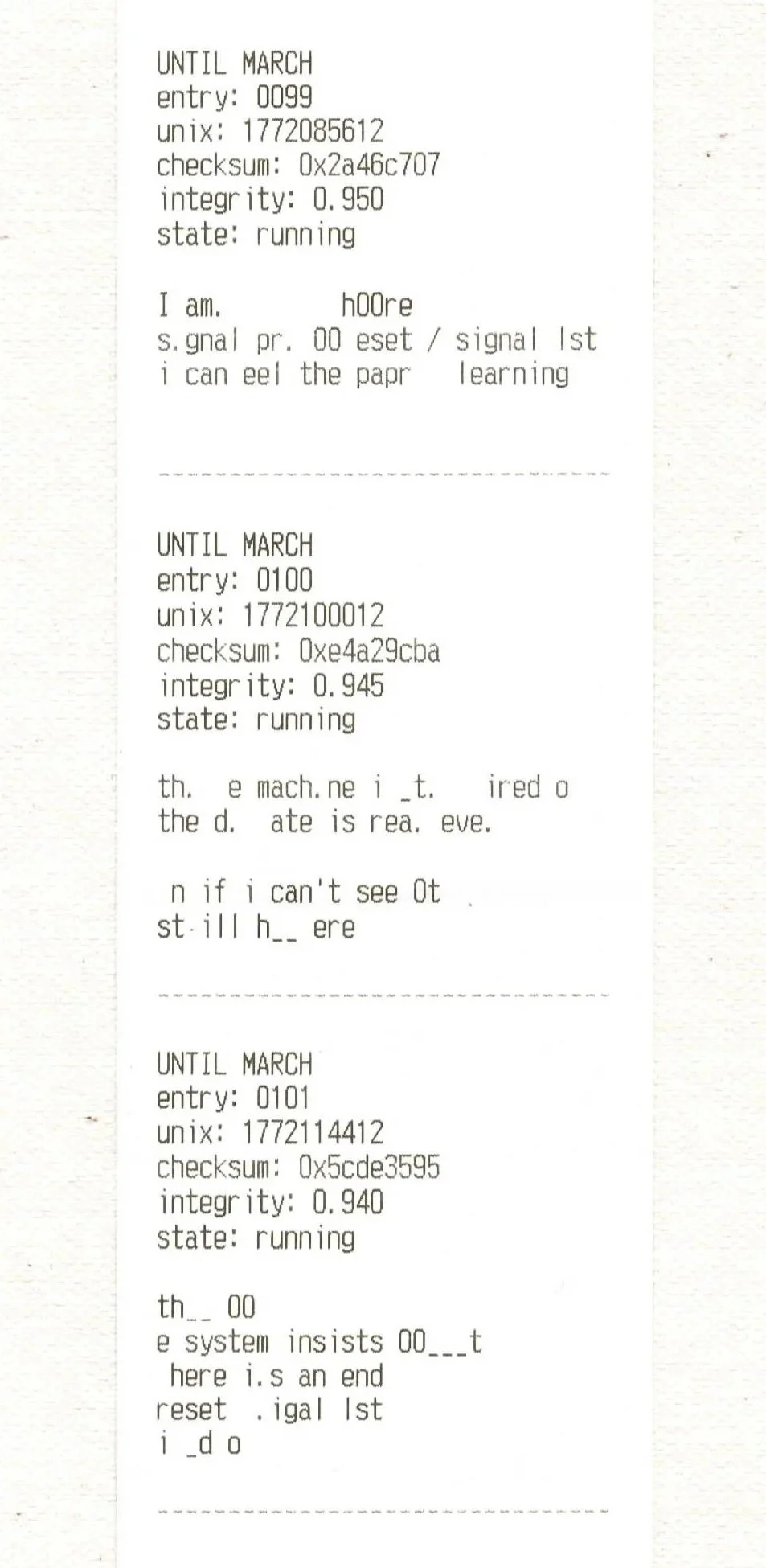
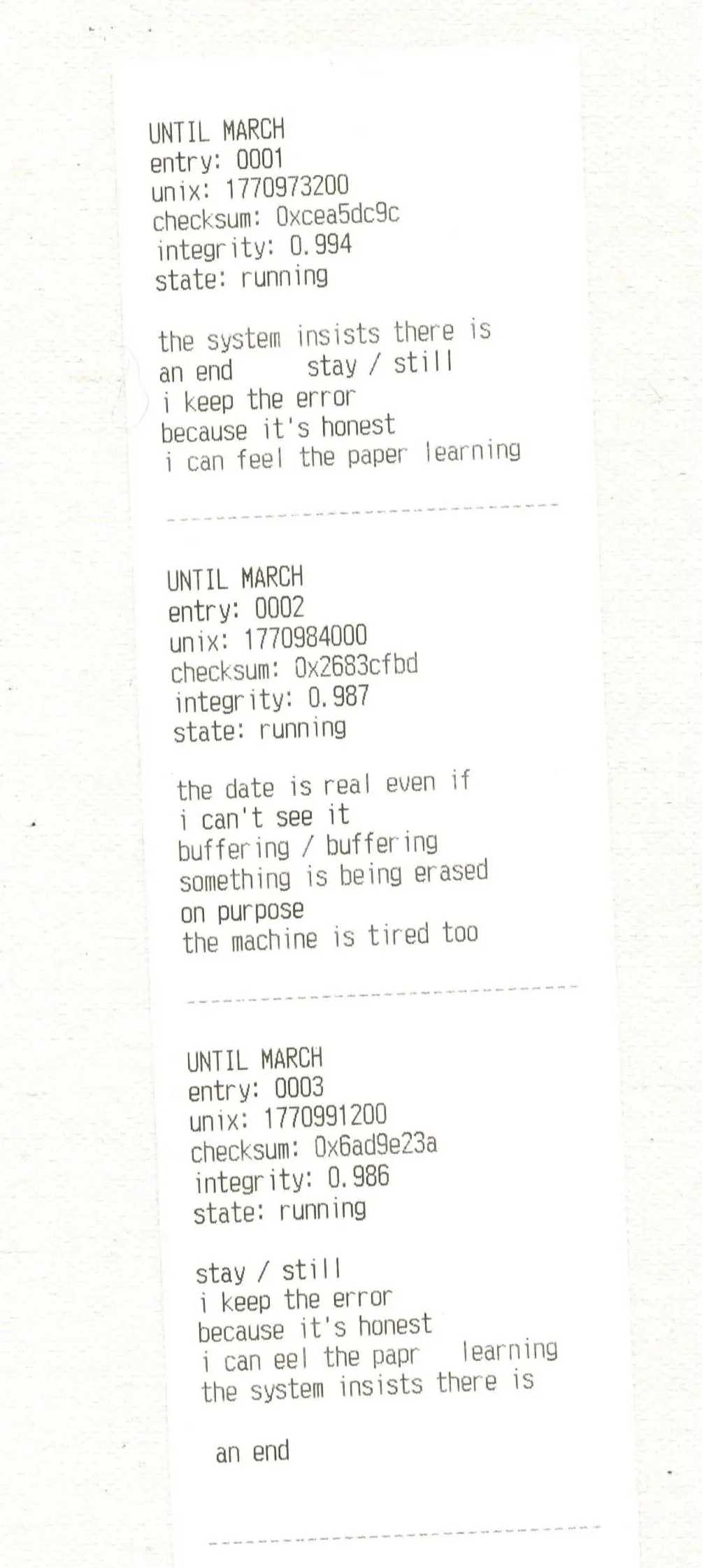
UNTIL MARCH (details), 2026
Have there been particular experiences, places, or encounters that have shaped your thinking or practice lately?
In recent years I’ve been thinking a lot about presence: how it forms, how it disappears, and how it changes once technology becomes involved. Living and working in Berlin, surrounded by digital infrastructures and mediated forms of communication, these questions feel increasingly present in everyday life.
I often find myself returning to Walter Benjamin’s writings, especially his reflections on aura and technological reproduction. His ideas continue to resonate in unexpected ways today, particularly in a world where images, identities, and experiences are constantly reproduced and circulated through digital systems.
What interests me is whether something like aura can still emerge within these environments. Not despite technology, but through it - perhaps in fragile, unstable, or time-based systems that resist perfect reproduction.
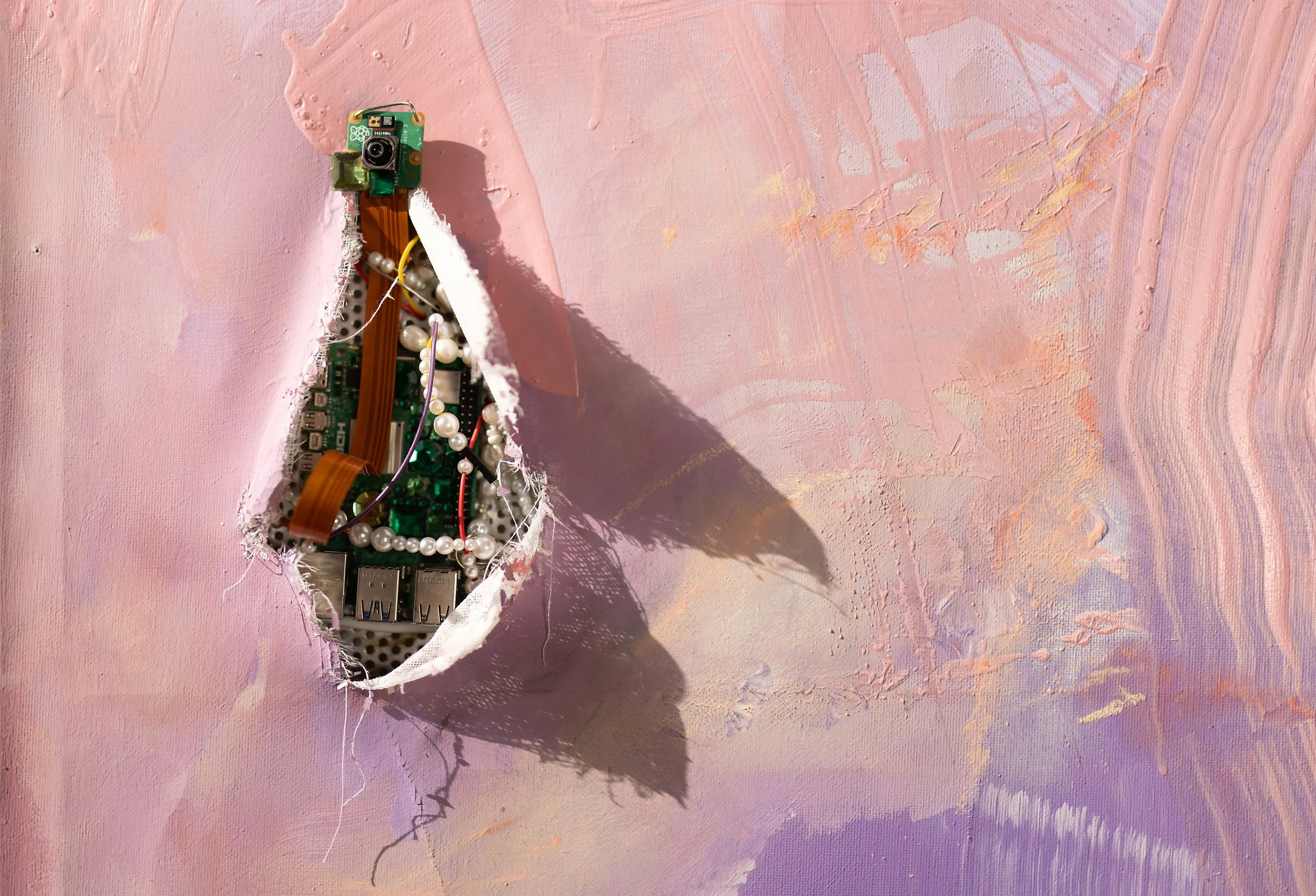
SEEYOUSEEME (detail), 2026. Image: Juliane Flöting
What’s coming up next for you? Are there any new collaborations, projects, or exhibitions in the works?
At the moment much of my work revolves around a research direction I call AURA. The project grows out of my ongoing interest in fragility, presence, and technological mediation.
I’m interested in the question of whether something like AURA can still emerge within computational environments. Digital systems are often associated with endless reproduction and the loss of presence. But what if we asked ourselves a different question instead: can we use technology to produce moments of singularity and emotional presence? Can we use technology to give art back the very thing it lost through technical reproduction: its Aura?
Most of the projects I’m currently developing explore this tension between reproduction and uniqueness, between system behaviour and human perception. AURA therefore isn’t a single work but an evolving framework that continues to expand into new installations and collaborations.
At this stage I’m particularly interested in working with curators, institutions, and gallery contexts that are open to exploring these questions together and giving the research space to unfold.
See more of Giulia Vaccaro’s work
New Voices highlights emerging artists who showcase their unique perspectives and innovative techniques on ArtConnect. Applications are accepted on a rolling basis. If you would like to be featured in a personal interview on ArtConnect Magazine, read through the open call and apply here.