JOSH ARONSON
JOSH ARONSON
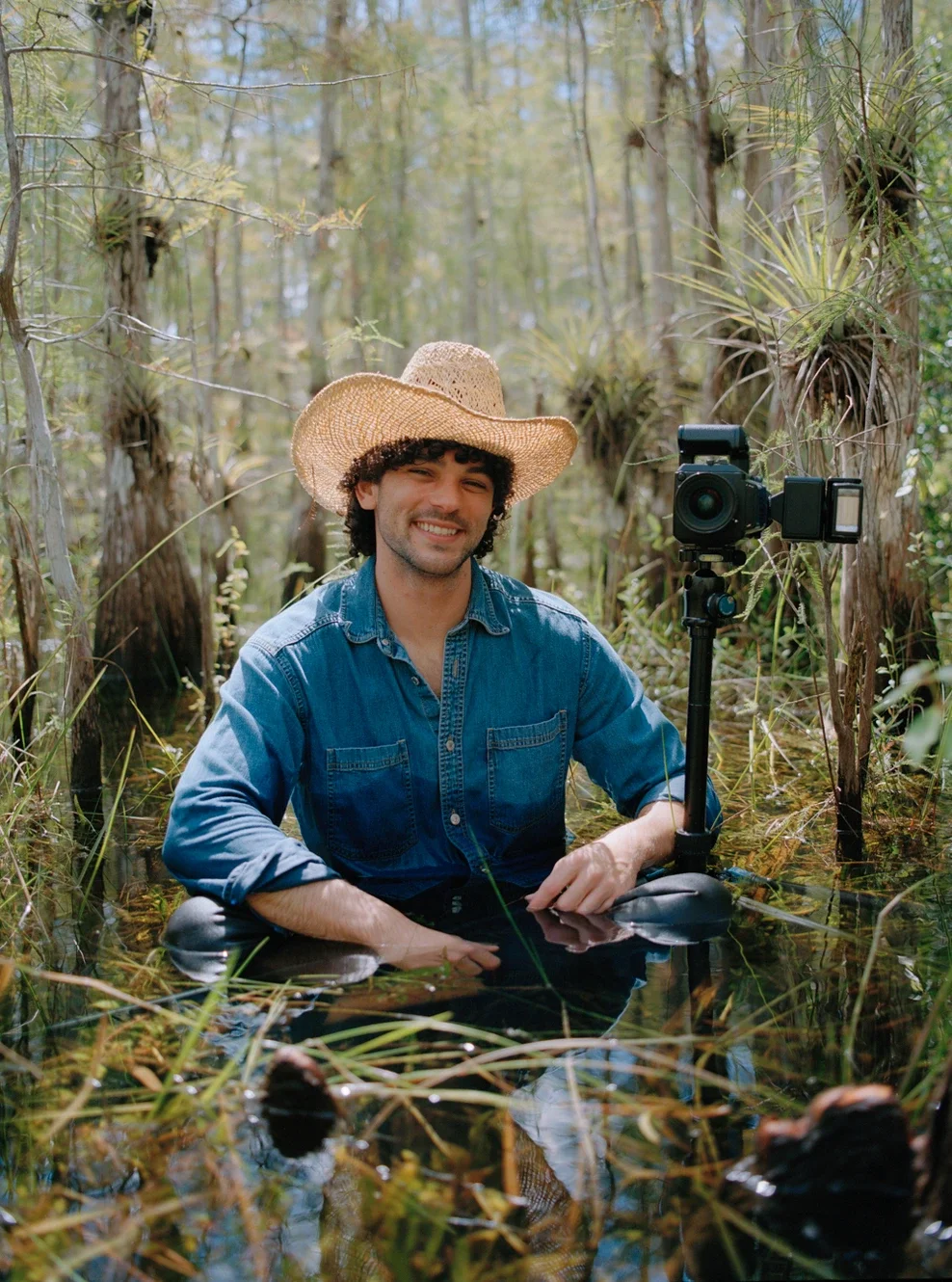
Josh Aronson (b. 1994, Canada) is a Miami-based artist whose work explores masculinity and landscape in the American South.
Josh is one of ArtConnect’s Artists to Watch '26
Josh Aronson (b. Toronto, Canada, 1994) is an artist and photographer raised in Florida. He received his B.A. in Philosophy from Northwestern University.
Publications include The New York Times, The Paris Review, Financial Times, Frieze, Italian Vogue, Teen Vogue, Dazed, i-D, and Apartamento. Clients include A24, Adidas, Chanel, Dior, Kate Spade, Puma, Ulta, Vrbo, and YSL.
His first zine Tropicana (2020) is accessible for viewing at The Metropolitan Museum of Art in New York and the Library of Congress in D.C., among others.
ArtConnect asked the winning artists to share with us a glimpse into their creative life to get a sense of their personal inspiration and artistic process.
Your project Florida Boys unfolded over several years and many journeys. What first drew you to begin that body of work?
It started as a pretty simple urge that had been building in me for years: I grew up in Florida, but I didn’t really know Florida. I knew the suburbs, the malls, the highways lined with palms, the edges. The springs, swamps, and forests felt like another country, even though it was my home state. And under that was a bigger question I couldn’t shake: how do you belong to a place that both embraces and excludes you?
Florida Boys began in late 2020, in that pandemic moment when everything got smaller and quieter, and the car became my studio. I wanted to look closer, step into the land I’d come to admire, and ask what stories it carried. I invited four men, one I’d photographed before and three I hadn’t met, on a road trip I put together through Instagram, basically friends-of-friends, looking for collaborators who felt connected to Florida’s strange DNA.
We started in Miami and drove north toward Big Talbot Island, Lake Apopka, and the Wekiva River. A lot of the guys were first-generation like me, and a lot of us had grown up without access to these places. So the project became a way of rehearsing presence: making images of tenderness, play, and friendship in landscapes that haven’t always offered that kind of ease to people like us. And honestly, I didn’t even develop that first trip’s film for years, but I knew something had clicked. It felt like I’d found a way to see home differently.
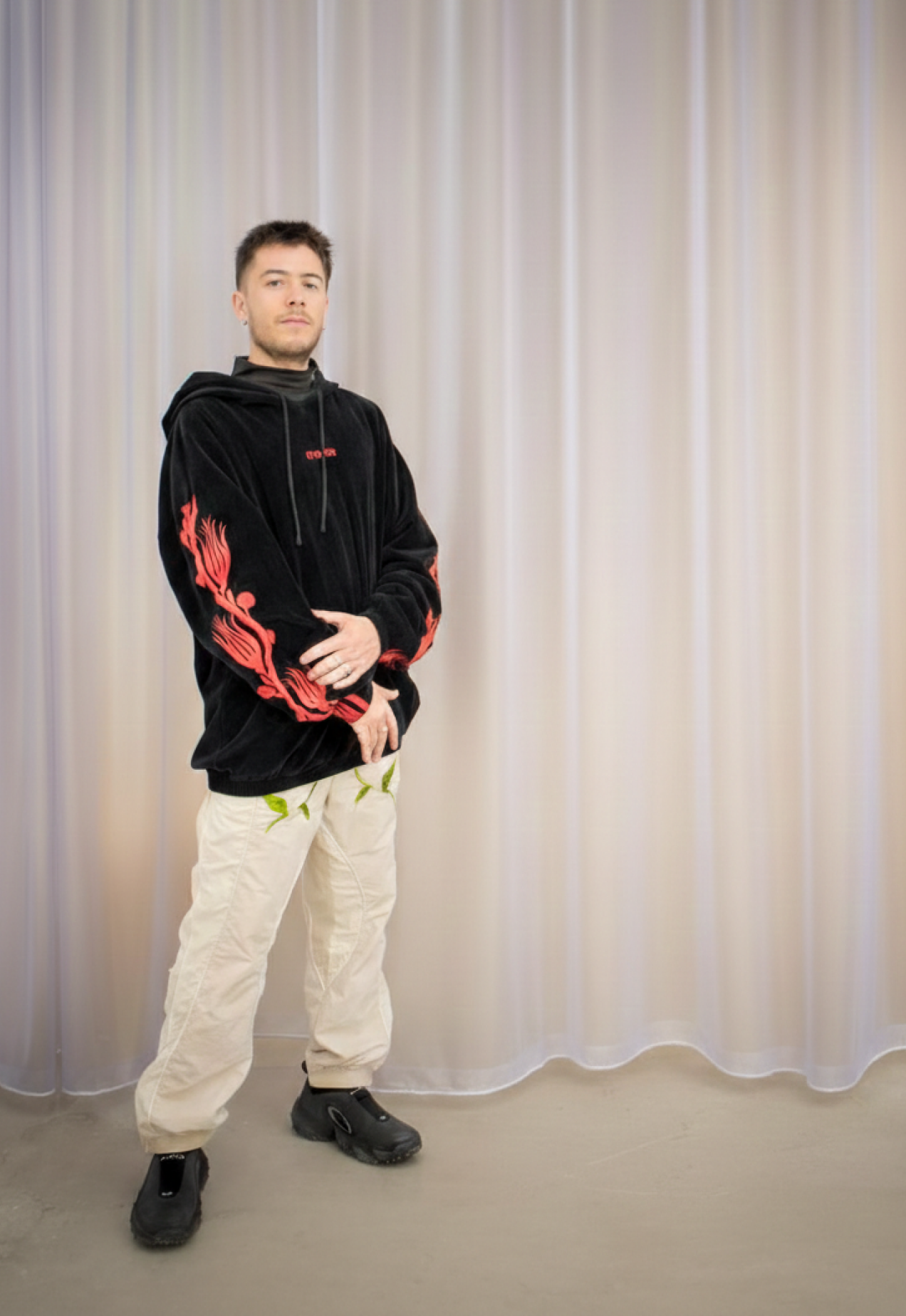
Roberto Rivadeneira
Curator
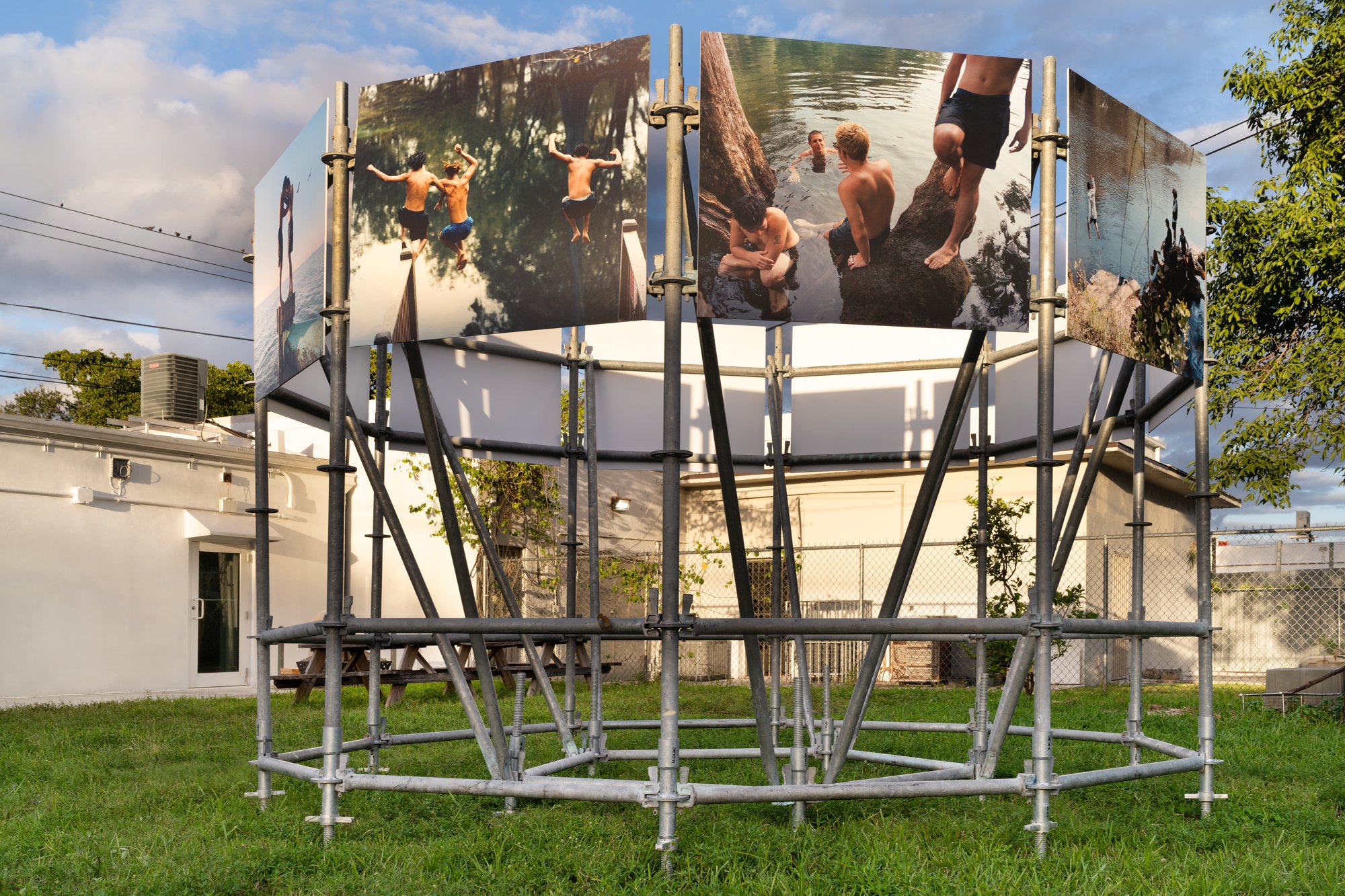
“Photography is one of the hardest practices to position within contemporary art, often sitting between documentation and research. Josh’s work stands out because it feels genuinely lived. His images capture everyday situations with a sense of presence and lightness that reminds you how meaningful the ordinary can be. I’m also deeply interested in how he installs his work, pushing the photographs beyond their surface and into a more layered, conceptual experience.”
How would you describe the core impulses or questions that drive your work today?
At the core, my work is driven by one question: what does it take to feel like you belong, inside your own body, inside a landscape, inside a story that wasn’t written with you in mind? I keep circling back to masculinity, not as a fixed identity, but as something learned. Something performed, inherited, and sometimes weaponized. I’m interested in the moments where it softens: where tenderness, care, and vulnerability slip through.
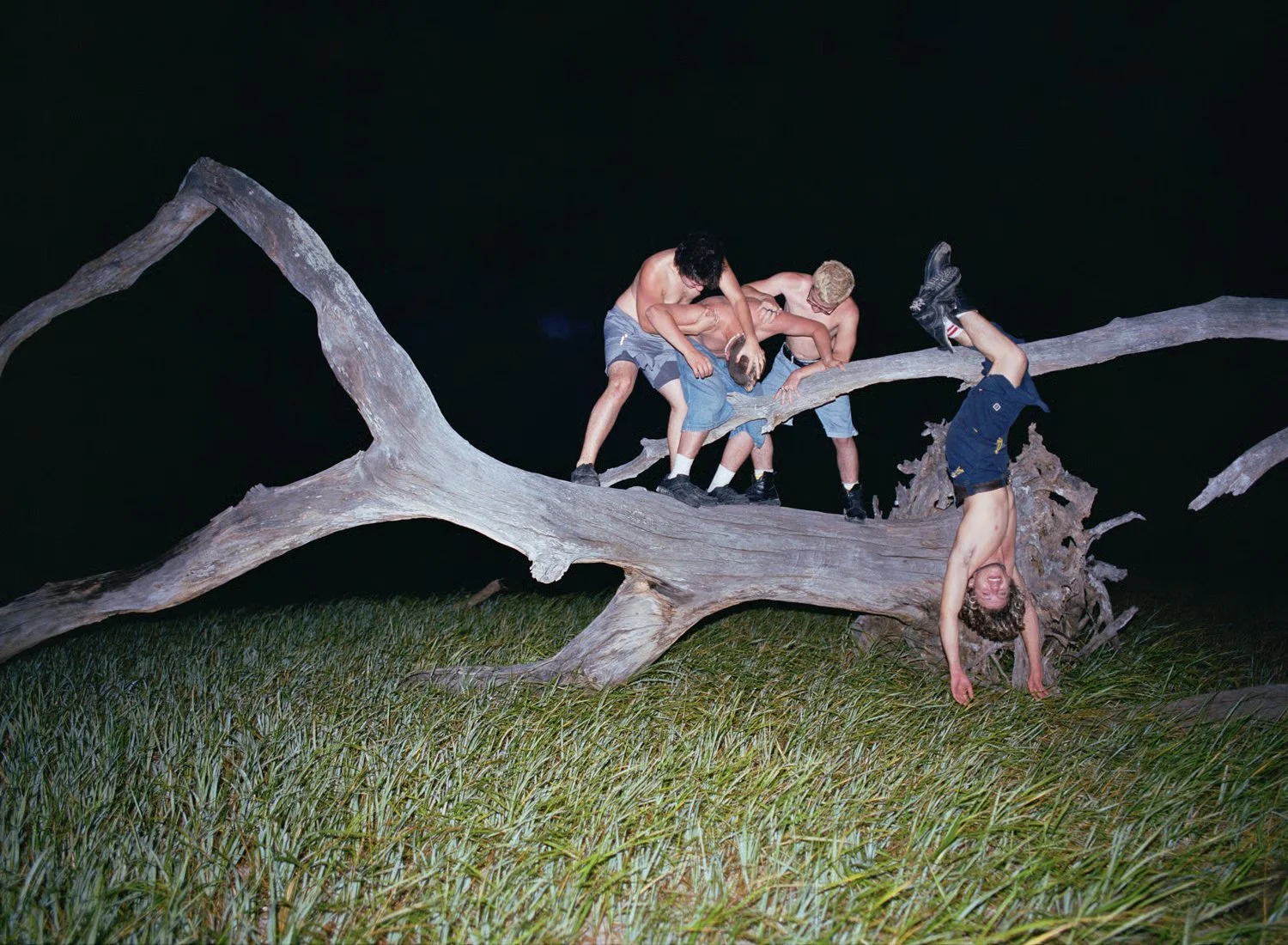
In Florida Boys, that’s the reason the pictures are staged. Constructing the scene lets us rehearse a different kind of presence. One that isn’t ruled by dominance or fear, and that doesn’t default to the screen-shaped version of manhood we’ve been handed. The other driving force is land: how the American landscape holds mythology and violence at the same time.
“Florida can look like paradise, but it’s also full of buried histories”
Florida can look like paradise, but it’s also full of buried histories: racialized access, displacement, environmental precarity. I’m drawn to that tension between beauty and threat, leisure and harm, belonging and exclusion. Photography becomes a way to sit inside those contradictions without flattening them. And then there’s time. I like duration. The slow build of a project, the lag between making and understanding.
Working with film, road trips, collaboration, and repetition is my way of resisting speed and certainty. I’m not trying to “capture” reality so much as build a space where other ways of being feel possible, both for the people in the pictures, and for me.
Your images seem to exist somewhere between memory, imagination, and lived experience. How do you think about narrative in your photographs?
I think of narrative as something you build, not something you simply record. Most of my pictures start with a feeling or a question, not a script. I’ll bring a group of people together, scout a location, and arrive with an intention. Then I’m paying attention to what the place offers and what the group brings into it.
The scenes are staged, but the emotional tenor, I hope, is real. That’s the balance I’m always after. I’m drawn to that space between memory, imagination, and lived experience because it mirrors how we actually carry our lives. Memory is unreliable. Myth is persuasive. History is often incomplete or withheld. Narrative lets me work inside all of that without pretending there’s one clean truth.
I can make an image that feels like a recollection, a dream, and a document at the same time. In Florida Boys, narrative is also a tool for reimagining who gets to belong in certain landscapes. These are places loaded with American mythology, and also with exclusion. By constructing scenes of tenderness, play, and intimacy, I’m not claiming the past was this way. I’m insisting the present can be, and that the future has room for it.
So the narrative is never just about one character or one moment. It’s about building a world. One where the viewer can enter, feel something, and maybe recognize themselves, even if they’ve never been to Florida.
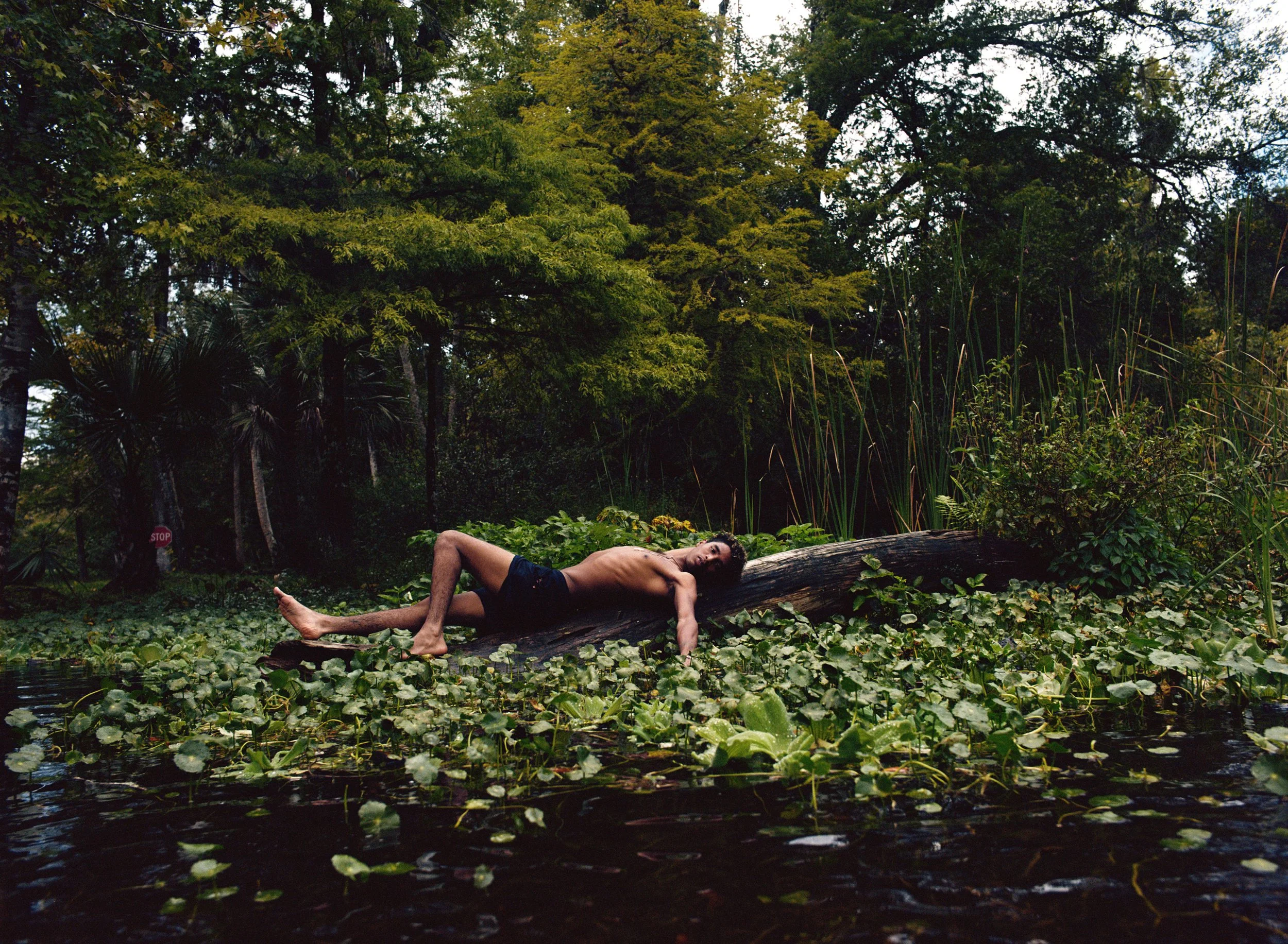
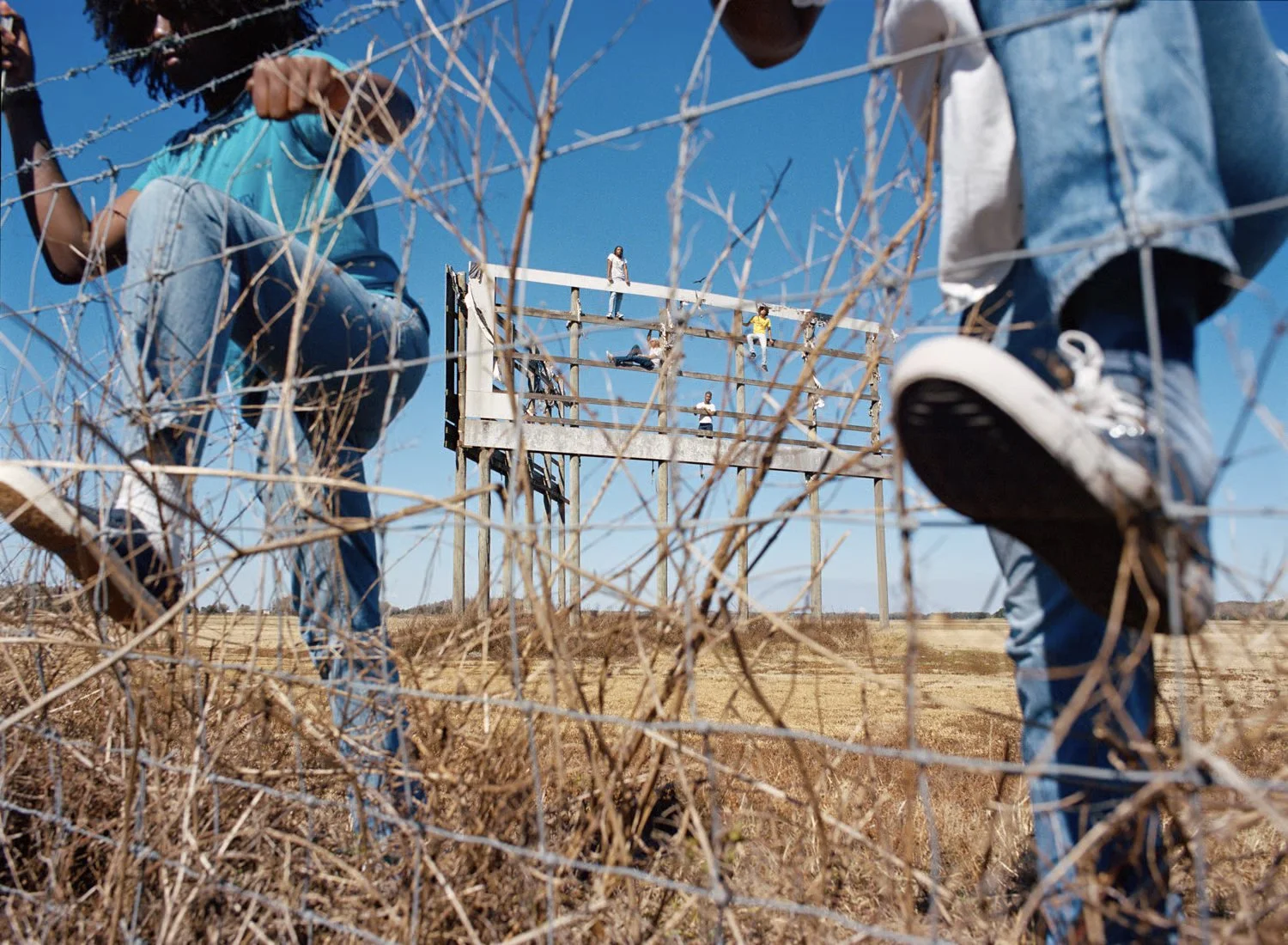
Josh Aronson. A shot from his series “Florida Boys”
The places you photograph often feel as alive as the people in them. How does landscape shape the emotional or conceptual atmosphere of your work?
Landscape is never a backdrop for me. It’s a character, and sometimes it’s the co-author. In Florida Boys, the land carries its own emotional weather. Florida can feel lush and generous, almost utopian, and then you remember what sits underneath that beauty. Histories of displacement.
“Landscape is never a backdrop for me. It’s a character, and sometimes it’s the co-author.”
The way leisure has always been tied to power. The way certain bodies have been welcomed into the outdoors, and others have had to negotiate fear, risk, or exclusion just to be there. That tension is part of the atmosphere I’m examining. I’m drawn to places where the land feels charged and complicated.
Springs, swamps, pine forests, beaches that look empty but never are. These environments hold American mythology, but they also hold the everyday reality of Florida today, including environmental precarity and a feeling that the ground is shifting. When I bring people into those spaces, especially first-generation and immigrant men from Miami, the landscape becomes a site of rehearsal. We are practicing presence. We are making room.
Emotionally, the land affects everything. It dictates the pacing of a scene, the way bodies move, the way light lands on skin. The kinds of gestures that feel possible. Conceptually, it shapes what the images are really asking. Not just who these boys are, but what it means to stand together in a place that has not always made belonging easy.
Photography becomes a way to build a counter-image, and the landscape is where that counter-image has to be tested.
You frequently photograph young men in moments that feel intimate or suspended in time. What draws you to these encounters?
I’m drawn to those encounters because they hold a kind of truth we don’t make much space for. So much of what we’re taught about masculinity is about certainty and performance. Control, toughness, distance. I’m interested in the opposite.
I’m looking for the moments when that performance drops, even briefly. When does a group settle into itself? When does tenderness show up without being announced? When does friendship look like care? Suspended time is important to me because it creates a pause from the pace of contemporary life and the constant pressure to be legible.
On these road trips, we’re away from the usual structures, away from the screen, and from the social scripts. That space lets something else surface. It becomes possible for my collaborators to be playful, soft, uncertain, affectionate, bored, or ecstatic. And for me, those states feel more honest than the narrow roles masculinity tends to offer. There’s also something personal in it. I’m photographing toward a sense of belonging I didn’t always feel growing up. The pictures are not just about Florida. They are about building a world where I could have existed more freely.
The intimacy is not an aesthetic choice first. It’s a value, or a way of saying that connection, vulnerability, and closeness are not weaknesses. They are the point.
Your projects involve extended time and shared experiences with the people you photograph. How do those relationships influence the images that emerge?
A lot of the time, the relationships don’t exist yet. They’re forming in real time. Someone agrees to come on a trip, often through a loose connection, Instagram, a friend of a friend. Then we’re suddenly together in a car for hours, in unfamiliar terrain, figuring out the day, the heat, the bugs, the water, the light. That shared experience accelerates intimacy. Not in a forced way, but in the way travel can.
You start paying attention to each other. You start looking out for each other. You start building a small temporary world. That early unfamiliarity also keeps the work honest. There’s an initial self-consciousness, a little distance, a little testing. I’m interested in that. I’m not trying to pretend we’re lifelong friends. I’m watching what happens when a group of young men meet and slowly decide what kind of environment we’re going to create together.
Staging plays a role here, too. When you construct a scene, you give people something to do together. A shared task. A choreography. It becomes a kind of social bridge. The image is not just a picture of a group, it’s evidence of a group forming. The tenderness in the work is not only something I’m depicting, it’s something we’re practicing. So the relationships influence the images because the project is partly about that process. Meeting and negotiating trust. Learning how to be around each other in the open. And then, sometimes, arriving at a moment where everyone feels suspended in the same weather, the same light, the same feeling.

Josh Aronson
Working on a long-term project inevitably changes the artist. How did that duration shape you or the direction of the work?
Duration changed everything. It gave the work a vaster temperature, and it changed how I understand what I’m even doing when I make a photograph. When Florida Boys began, I was working through a very immediate set of curiosities about masculinity, belonging, and the feeling of being close to Florida but not fully inside its mythology. Over years of road trips, scouting, waiting, returning, and living with the images, those curiosities didn’t resolve. They got more specific.
I started to see how much the land was shaping the work, not just visually, but historically and emotionally. The project pushed me to read more, to look harder at archives, and to think about Florida not as a backdrop, but as a complicated inheritance. The time also taught me to trust delay. Shooting on film, sometimes not seeing an image for years, creates a gap between experience and understanding. That gap is productive for me. It lets the work move from something personal and immediate into something more layered, where memory, imagination, and history can sit in the same frame. And on a human level, repetition made me more attentive.
Each trip is a new group, a new dynamic, a new negotiation of trust. Over time, I learned how to create the conditions for something tender to happen without forcing it. I learned that the work isn’t just about making individual pictures. It’s about building a way of working, a way of being with people, and a way of entering the landscape with care. So the duration shaped the direction of the project by widening it. The work started as a way to photograph toward belonging, and it became a method of world-building. Sort of like an ongoing practice of insisting that other ways of being, and being together, are possible.
You studied philosophy before committing fully to photography. Does that way of thinking still inform how you approach image-making?
Yes, in a quiet but constant way. Studying philosophy trained me to sit with questions without rushing to resolve them. It made me suspicious of easy answers and fixed meanings, and it sharpened my attention to how perspectives get built. What gets framed as natural, inevitable, or true. That way of thinking critically and openly is still in the work, even if the photographs are not “about” philosophy. It also shaped how I think about images as arguments.
A photograph can feel immediate, but it’s never neutral. It’s a construction. It carries assumptions about beauty, power, gender, race, class, land, etc. When I stage a scene, I’m acknowledging that construction rather than pretending the camera is simply witnessing. I’m making a world on purpose, and asking the viewer to enter it and decide what they feel and what they believe. And philosophically, I’m still drawn to questions of perception. What does it mean to look, and to be looked at? What happens when an image makes you feel something before you can explain it? That’s often my test.
If a picture doesn’t make me feel, it’s usually not worth pursuing. So yes, philosophy still informs my approach, mostly as a discipline of attention. It keeps me oriented toward complications. It reminds me that work can hold contradictions, and that uncertainty can be productive.
Looking ahead, what questions or ideas are currently present in your practice?
Right now I’m thinking often about power and land, in very direct terms. Who can protect the landscape? Who gets pushed to the margins? Who has the access to protect it, and who is treated as disposable inside it? I’ve been photographing members of the Miccosukee Tribe in Big Cypress, and that’s changed how I’m holding these questions.
The Everglades is not an abstract environment. It’s homeland, it’s stewardship, it’s a living system, and it’s also a site where the state keeps trying to assert control. The presence of the Everglades Detention Center inside Big Cypress makes that impossible to ignore.
So the questions I’m asking through photography are the same: what is the connection between identity and landscape, or how does landscape shape identity? What does it mean to belong to a place? Who gets to belong in a landscape? And who gets to protect it? Now I’m thinking more about sovereignty, stewardship, and what it means to inherit traditions that are tied to responsibility.
Anything else you would like to add—perhaps something about your process, influences, or what’s next for you?
I just returned from San Francisco, where I hosted my artist-led public program Photo Book Speed Date at San Francisco Museum of Modern Art. It’s a format I started as a way to gather people around books in an intentional, wholesome way. You bring a photo book you love, pair up, and share it in timed rotations. It’s playful, but it creates real connections between strangers.
On March 7, I’m hosting the next edition at the historic Miami-Dade Public Library in Downtown Miami. That community connecting work feels deeply connected to my photographic practice. They’re both about building spaces where images are encountered slowly and collectively, and people can feel a sense of belonging.
This year I’m also a Studio Artist-in-Residence at Deering Estate, an ON::View Artist-in-Residence at ARTS Southeast, and the Leonian Foundation Fellow in Photography at Virginia Center for the Creative Arts. Each residency gives me time in a different landscape, which inevitably shifts the questions I’m asking and how I’m asking them, from Cutler Bay in Florida to Savannah in Georgia to Amherst County in Virginia.
Works from Florida Boys are currently on view in First Look at Panopticon Gallery through April 27; Context at Filter Photo through April 18; Turning Points at Cabrillo Gallery through April 10; and Infinite Weight/Present Histories at the University of West Georgia through March 26.
What’s next feels less like a pivot and more like a widening. Continuing Florida photography, deepening the conversations around land and belonging, and making space for new collaborations that push the work into territories that feel necessary right now.
See more of Josh’s work