
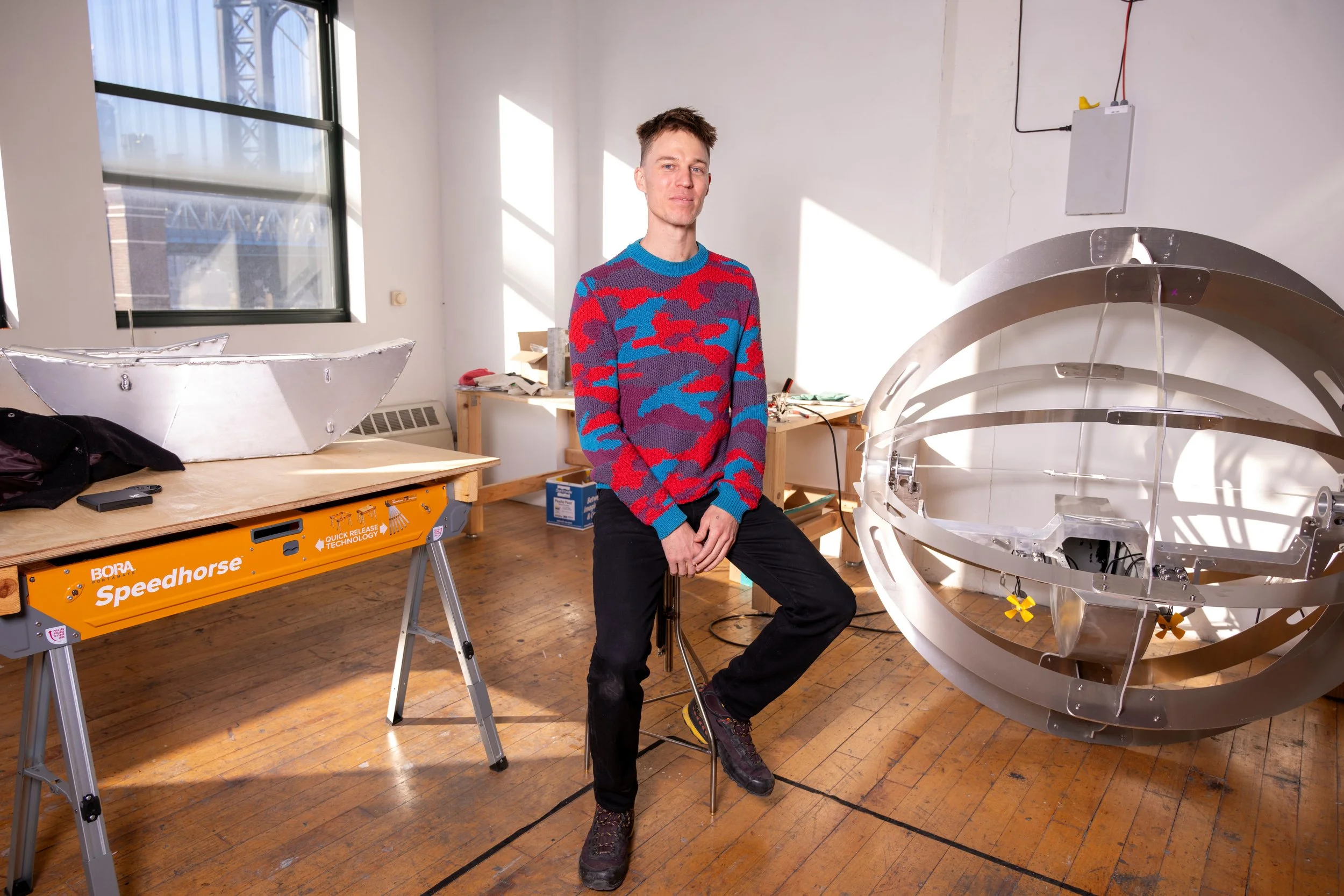
Michael Candy
Constructing engineered phenomena that reconfigure space and perception.
Michael Candy is spotlighted in the New Voices series, which highlights emerging artists who showcase their art on ArtConnect.
International artist Michael Candy is known for kinetic sculptures, interactive installations, and video works that challenge the socio-political implications of contemporary technology. His practice navigates shifting landscapes of automation, mythology, and agency, constructing engineered phenomena that reconfigure space and perception.
His works emerge as social experiments and interventions, transforming environments through movement, light, and interaction. Drawing from robotics and emergent technology, these autonomous systems act within the world rather than merely reflecting it, generating new conditions and anomalies that unfold in real-time.
Curious to gain more insight into his artistic approach, we asked Michael a few questions about his practice.
Your work draws from industrial design, robotics, and emergent technology. Can you recall a specific moment, influence, or experience that pushed you toward these materials and systems? How has that early spark evolved into the language you work with today?
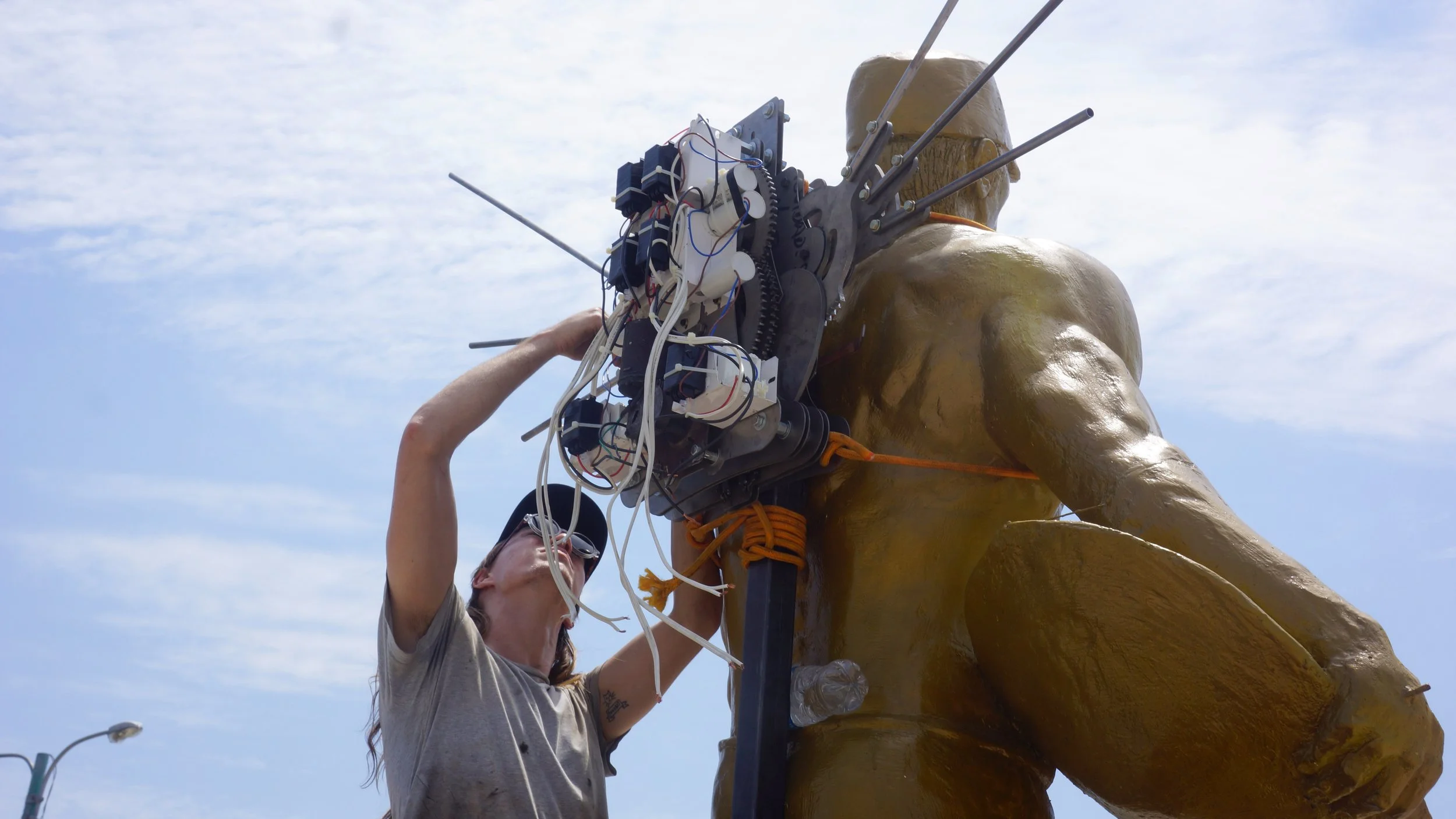
Core to my philosophy as an artist is doing my best to understand the tools and materials I’m working with - learning through my hands by breaking open all kinds of devices and objects to understand their inner workings and secrets. From a very young age I was always taking things apart to see how they worked, and given that I grew up in the 90s, things were still made of real “stuff” like motors and resistors, so hardware hacking was intuitive and easy. Sculpture became part of this process as I found ways to reconfigure these components for alternative functions.
You’ve described your works as “engineered phenomena”. Could you take us inside one recent project and explain how the idea moved from an initial impulse or problem to a functioning object in the world?
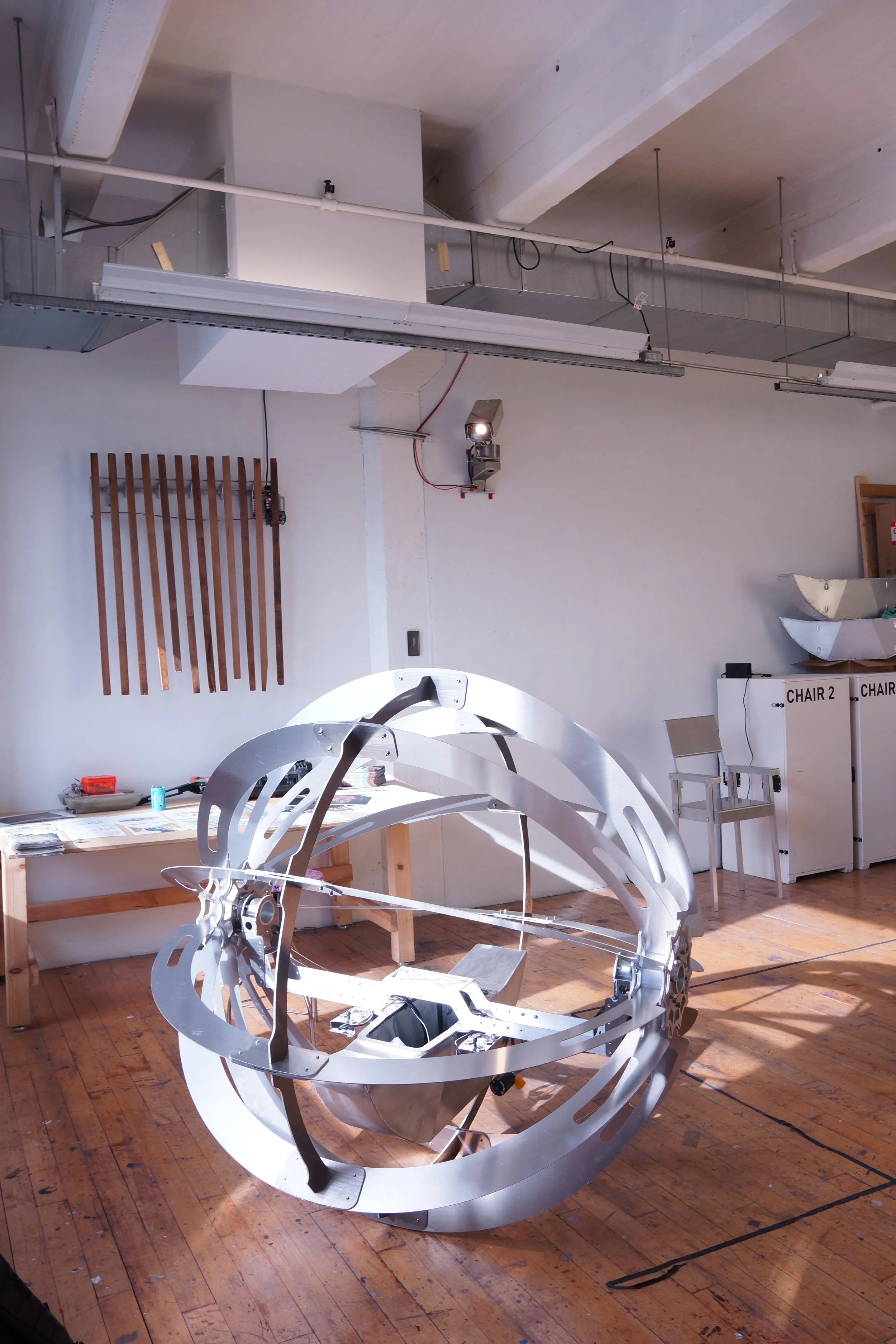
Water Sculptures, Studio Image (2025)
Phenomena or anomalies are usually words I gravitate towards upon completion of new work. My process of production is so materially informed that I often find myself working through several prototypes and iterations at varying scales before arriving at the final outcome. Because of this, when reflecting on a completed work I sometimes find it difficult to conceptualize how I arrived at its conclusion. Almost all my work is intended to solve problems that don’t exist, and my fabrication methodology reflects that too.
Recently I completed Water Sculptures—a series of three robotic water machines designed to manoeuvre through old canal systems as autonomous fountains. The final version followed four or five complete prototypes and revisions over several years. I work this way because I want to drag things out of the concept or sketch phase as soon as possible. I work much better when I can feel the parts in my hand, know how they fit together, and understand how it might exist in the world.
Each one of my major projects is an arbitrary process of reinventing the wheel and then writing the manual on how to use it. If I kept making the same thing every time, this would surely get streamlined - but I prefer to keep a studio, not a factory.
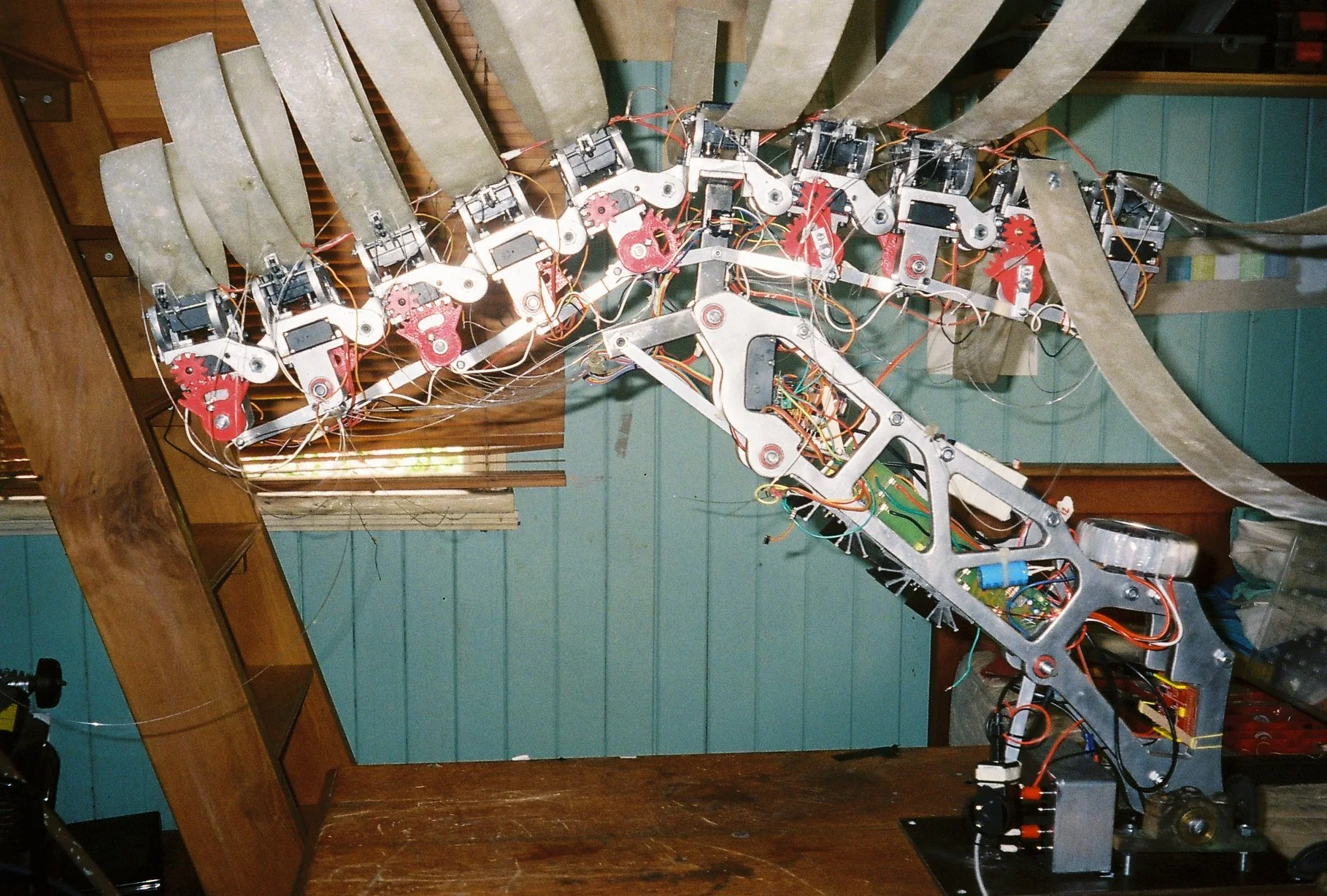
Venus (2011)
“Each one of my major projects is an arbitrary process of reinventing the wheel and then writing the manual on how to use it.”
Much of your practice interrogates the socio-political dimensions of contemporary technology. Which systems, infrastructures, or emerging behaviours are most on your mind right now, and why?
Art sometimes has a tendency to latch onto the latest buzzword or tech hype and see how they can twist it into some form of clickbait headline. Things like Drones, NFTs, VR, Metaverse, Unreal Engine, Blender, 3D printing, Robotics and AI have dominated the last 15 years of tech/art reporting. Many of these are tools I do use in the production of work, but never the sole outcome.
Technology is such a ubiquitous and unavoidable tool of modern existence it's impossible to deny its influence. For the last decade most figurative painting has been framed through one of the pre-defined focal lengths of an iPhone lens and later captured through the same device. I find the subtle bleed of these influences a perfect reflection of the impact of these tools in contemporary art production.
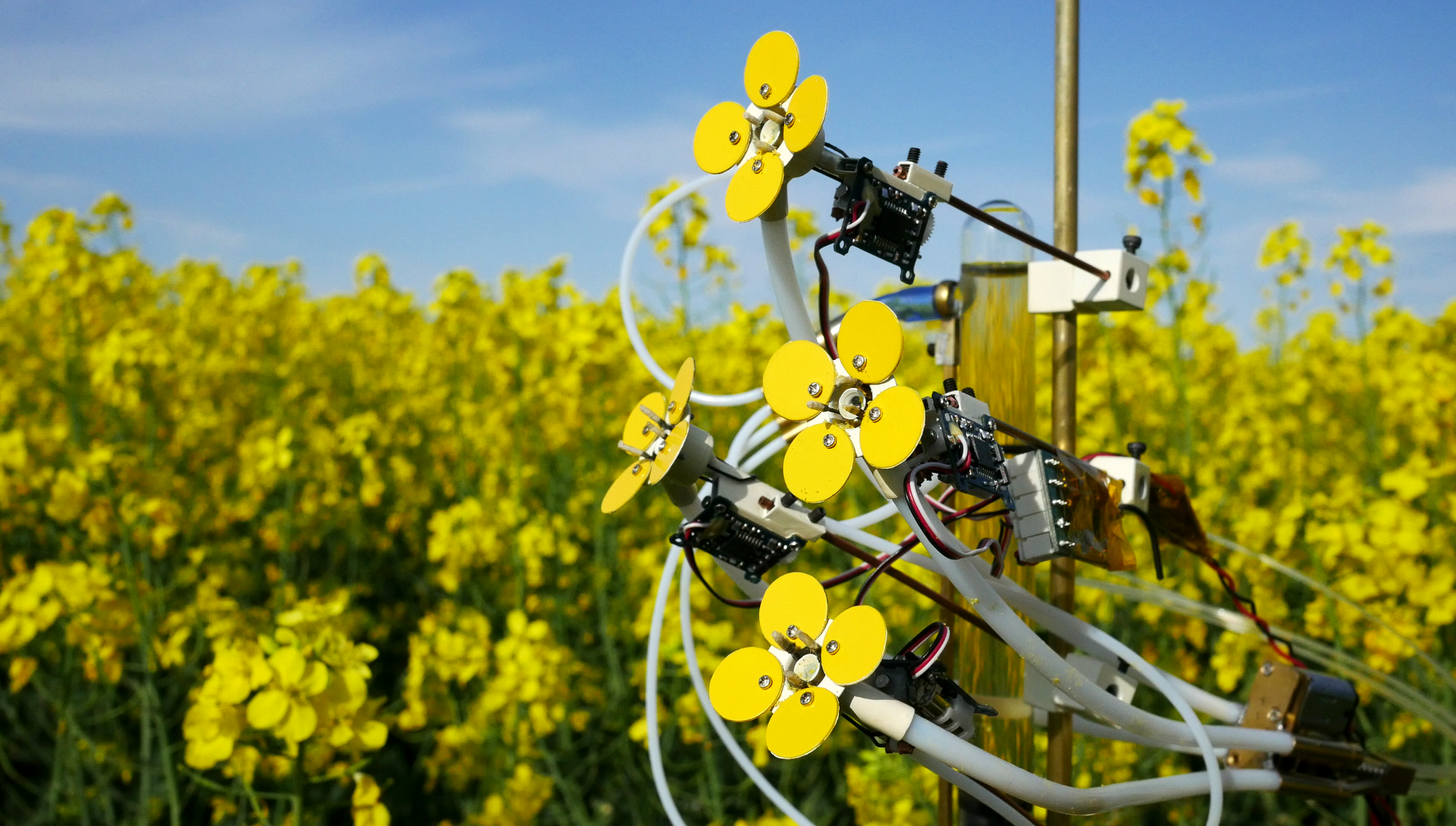
Synthetic Pollenizer (2017)
Your kinetic and interactive sculptures depend on movement, unpredictability, and human presence. How do audiences change the work (either mechanically or conceptually) once it enters public space?
I want to engage with the physical world while people still have a vague interest to exist within it. Creating interventions, scenarios or objects that cause physical affect is something I find myself coming back to.
“I want to engage with the physical world while people still have a
vague interest to exist within it.”
Much of my work exists at a non-consumable scale given the exponential cost of production or its size. Many of these projects can only exist in larger institutions and are usually born on a commission basis.
If I am creating work for people to observe/participate in, there needs to be a transaction in which experience is the reward. And if a work is designed to do something, it better be built reliably enough to still be doing that thing 3 months into the exhibition.
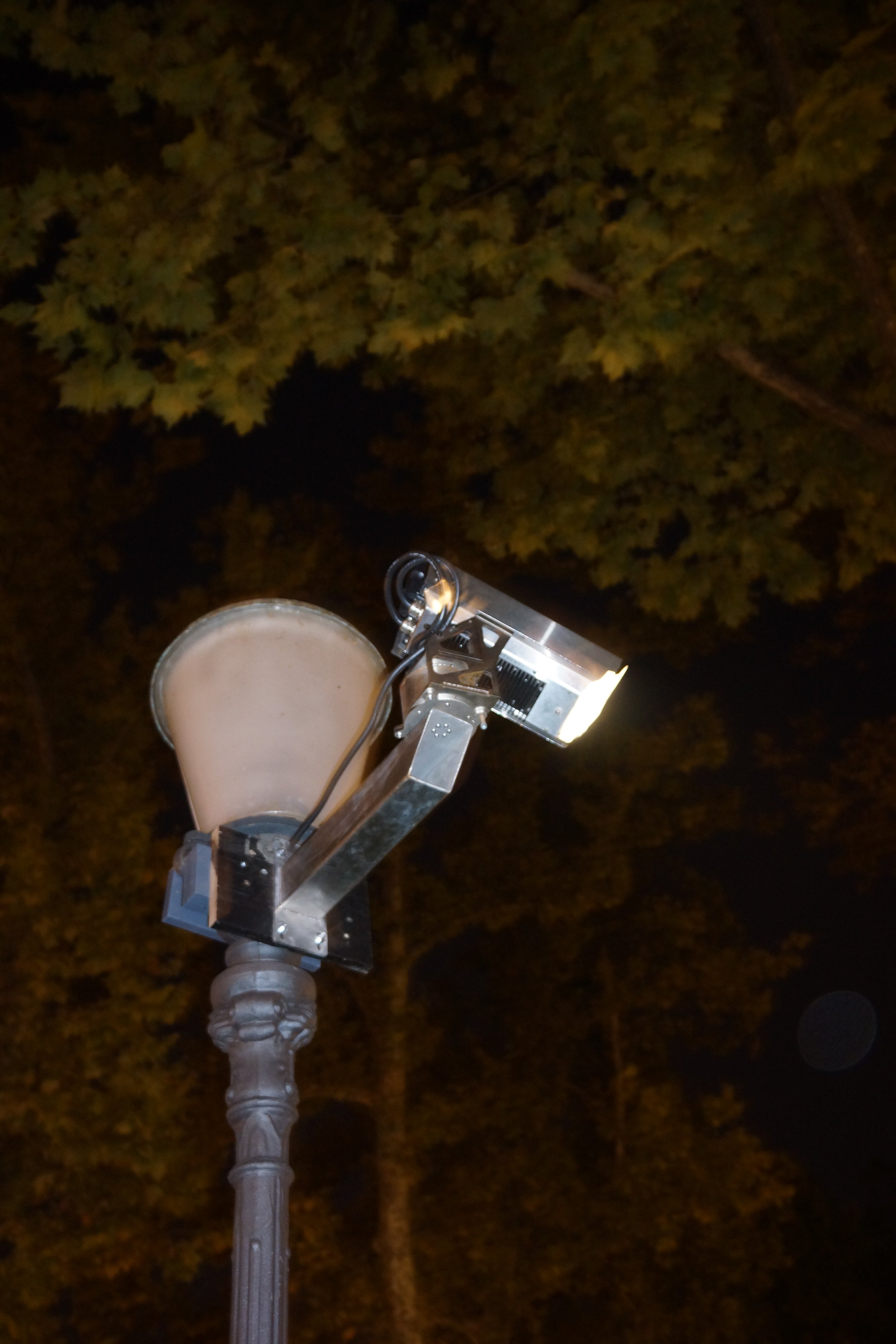
Persistence of Vision (2023)
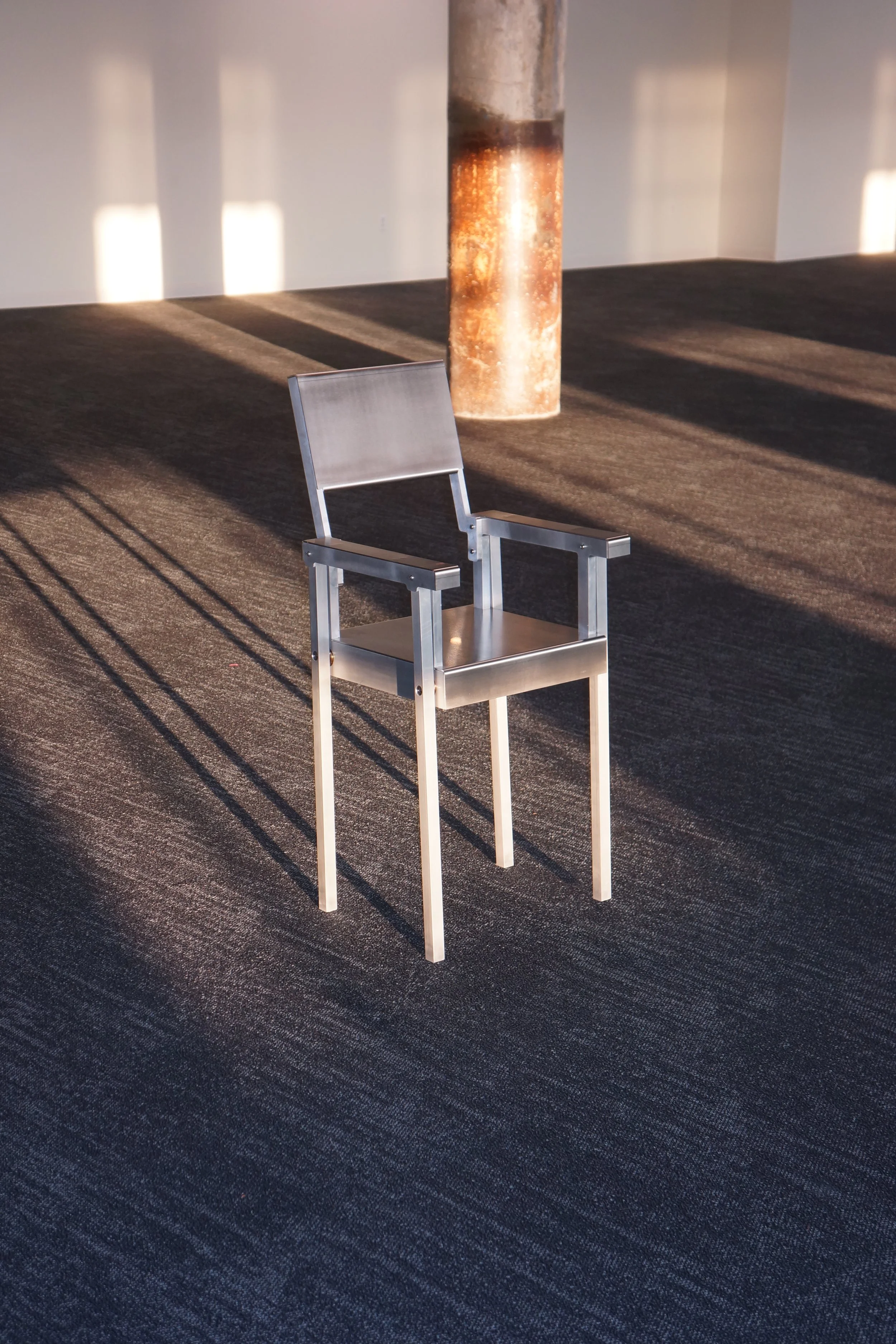
Chair 2 (2024)
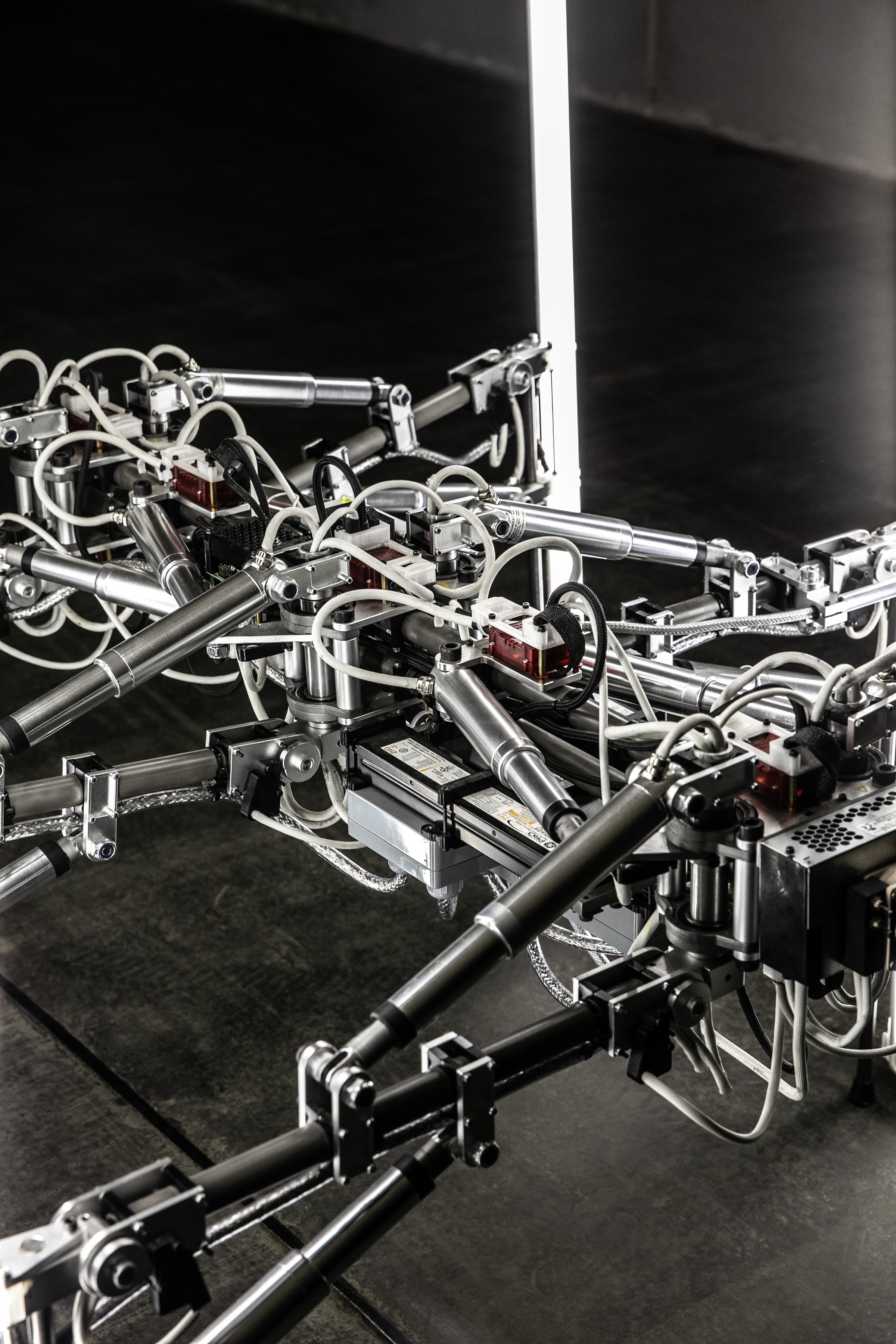
Cryptid (2019)
Your projects often confront the moral and ethical aftershocks of digital culture. Where do you see the sharpest ethical friction in the technologies you work with, and how do you translate that tension into form?
Working with a medium that's ever-evolving I find there's always a new surplus of dystopian cruel machinations being drawn into existence, yet technology as a whole is nothing new. I find it important to consider non-western and historical perspectives and this is where residencies represent an important cultural exchange.
The process of drawing these dialogues and concepts into form is similar to my sculptural process. I try to create an approximation or prototype of the event or sculpture as early on as possible. This way I can see how this concept might exist as a physicality and that's where the interplay begins.
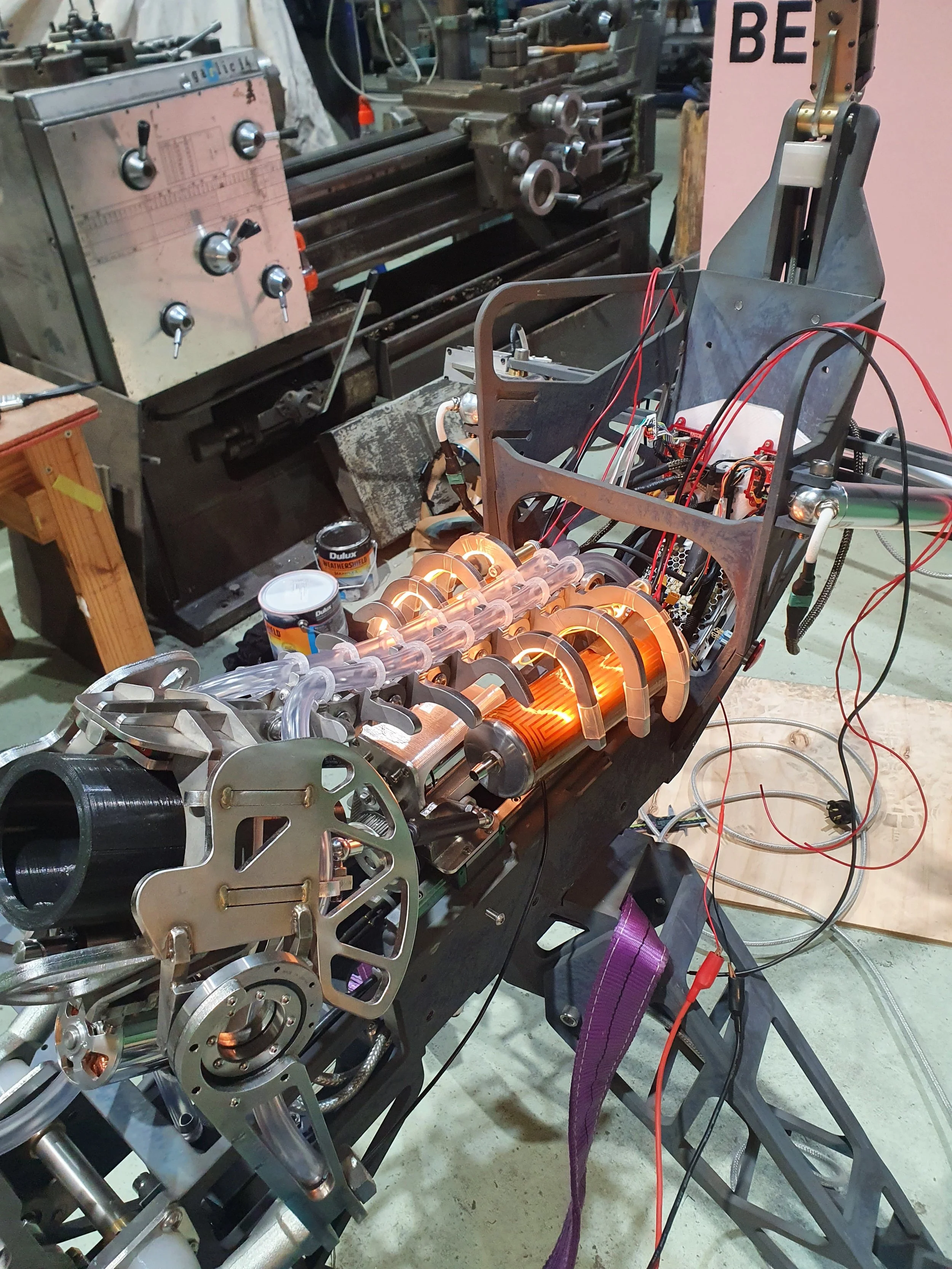
Celestial Bed (2022)
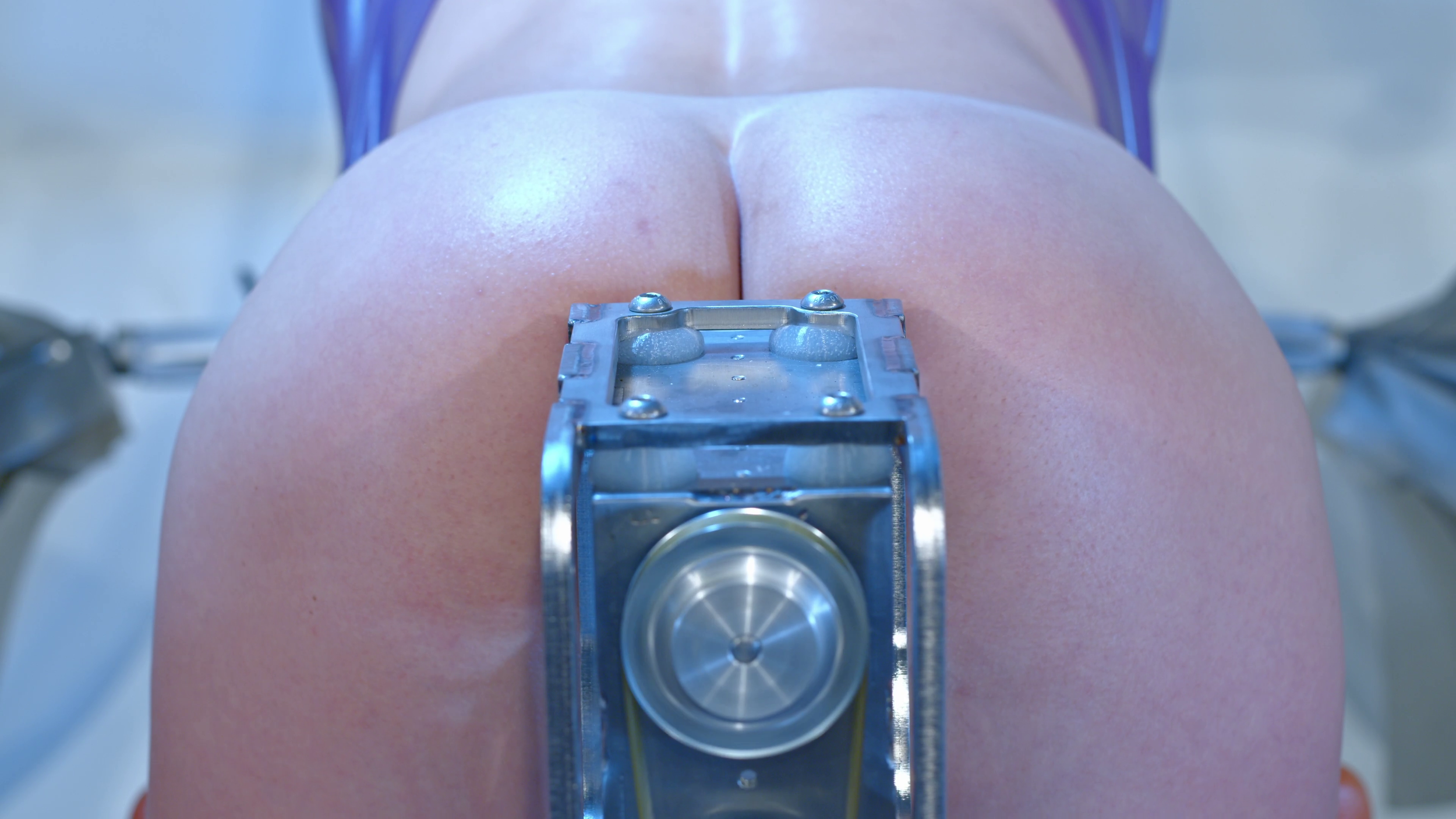
Celestial Bed (2022)
In 2015 I travelled to Nepal on residency to explore the spiritual synergy of man and machine. This was initiated by my fascination with the machination of ancient prayer wheels in Buddhist temples and Masahiro Mori’s seminal text “The Buddha in the Robot”. At the end of the 3 month residency what emerged was an 18 minute film of robotic puppets playing out a bastardized retelling of the tale of a local bodhisattva. This was done with consent and collaboration from locals as the small robots found their own form as characters burdened by their environments playing out a surreal narrative.
Ether Antenna Trailer (2015)
Looking ahead, are there technologies, materials, or problem-spaces you feel drawn to but haven’t explored yet? And is there anything in your current studio practice that hints at where your next body of work is heading?
I don’t think capital “A” art is a successful vehicle for political commentary or social change, and neither do I think the contemporary obsession of identity in art is of any importance. ‘Art’ is a confused and deluded void within the creative industries which is capable of catalyzing intimate experiences, insights and feelings that are impossible in most other fields.
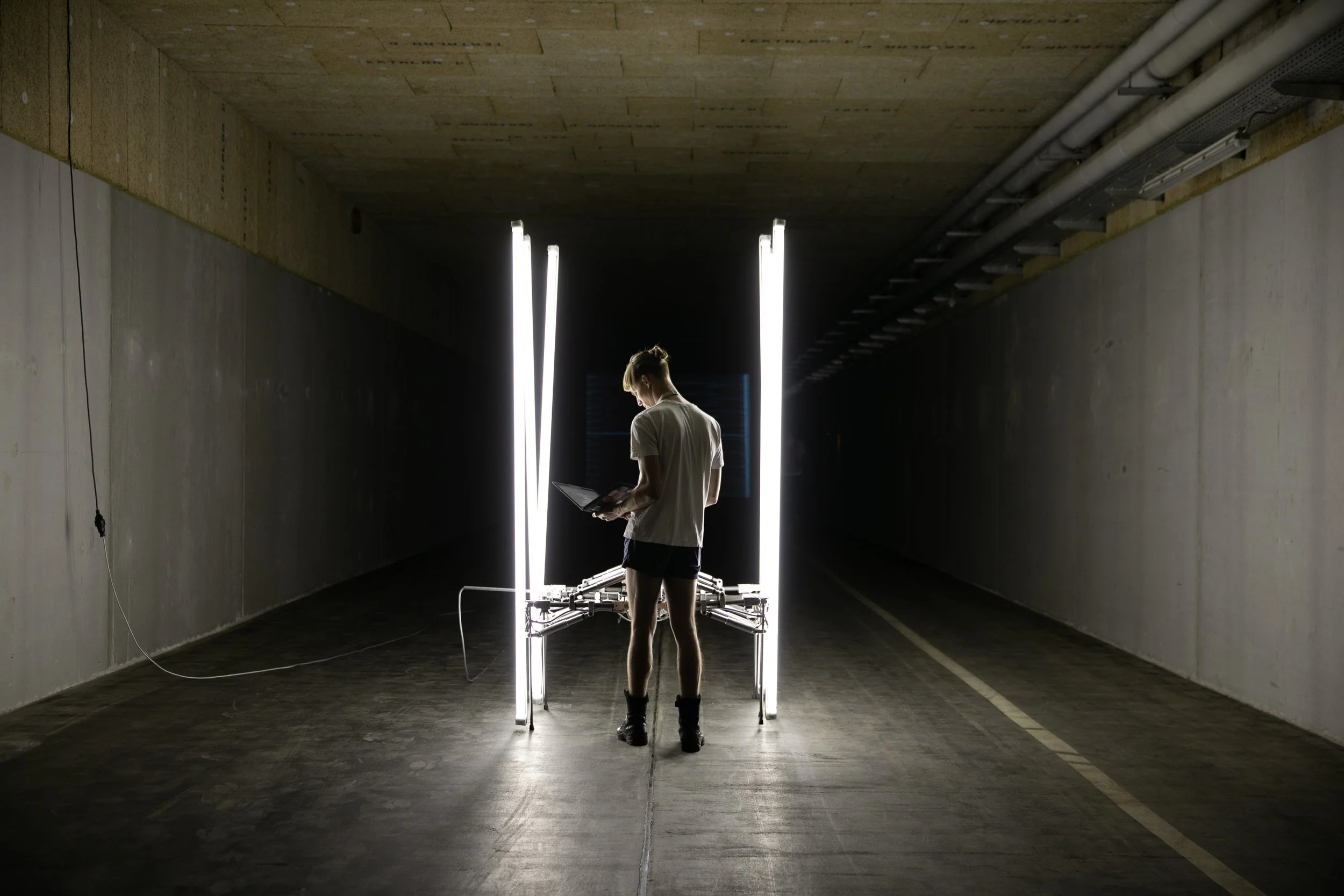
That said I do find emerging social or technological trends a great inception point for new concepts in my production process. To be short, I’m leaning towards event-based ideas that involve performance, participation, and conflict as a means to create new boundaries for experience as duration becomes part of the work.
New Voices highlights emerging artists who showcase their unique perspectives and innovative techniques on ArtConnect. Applications are accepted on a rolling basis. If you would like to be featured in a personal interview on ArtConnect Magazine, read through the open call and apply here.