
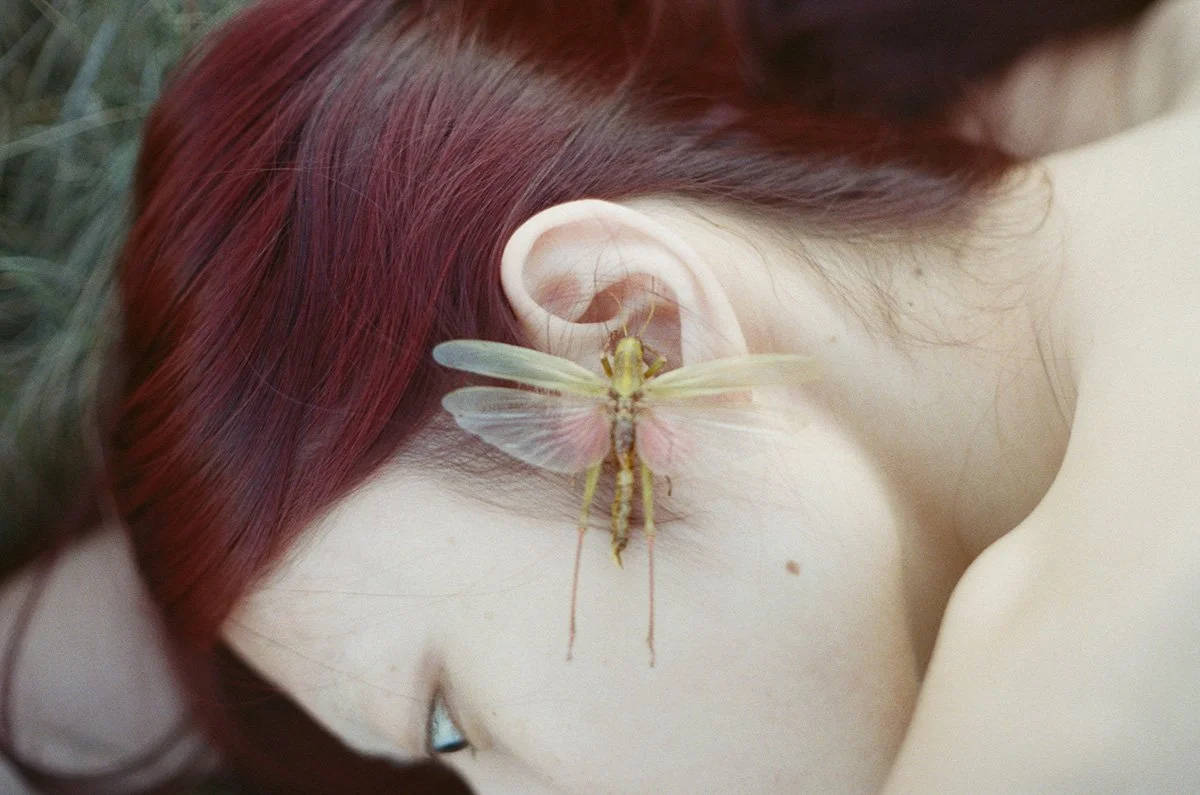
Morrison Gong
New Voices
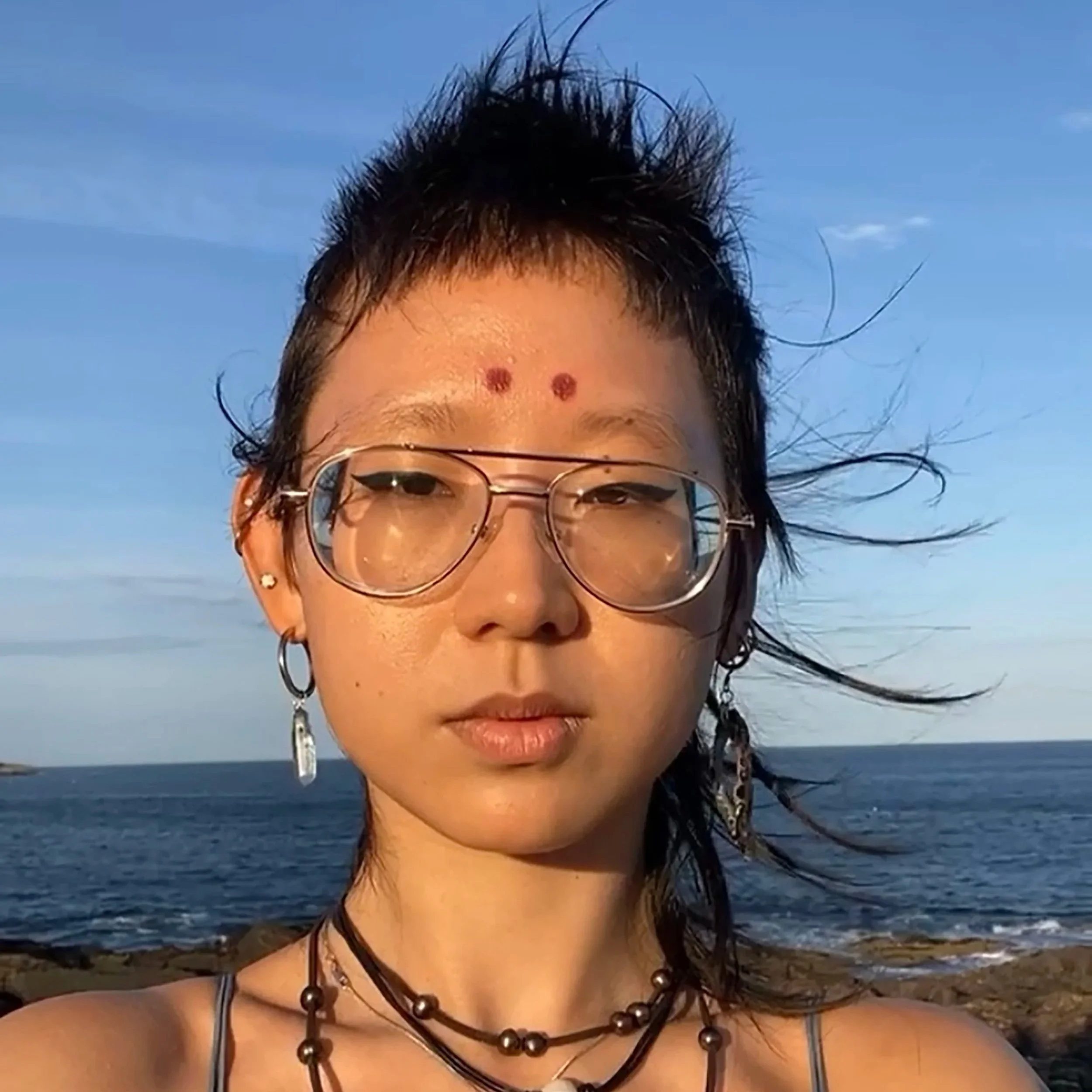
Morrison Gong is spotlighted in the New Voices series, which highlights emerging artists who showcase their art on ArtConnect.
Morrison Gong works across photography, writing, performance and moving images. They invoke the body as a site of haunting, wounding, conjuring and mythmaking. Communing with insects, aquatic creatures, relics, ceremonial objects, Gong fuses their practice with erotic, animistic and funerary rites. Their video works have been shown at Anthology Film Archives, Microscope Gallery, Vox Populi Gallery, and CROSSROADS presented by San Francisco Cinematheque. Their photography has been featured on It’s Nice That and Whitehot Magazine. Gong has taught photography and interdisciplinary practice at the International Center of Photography.
Curious to gain more insight into their artistic approach, we asked Morrison a few questions about their practice.
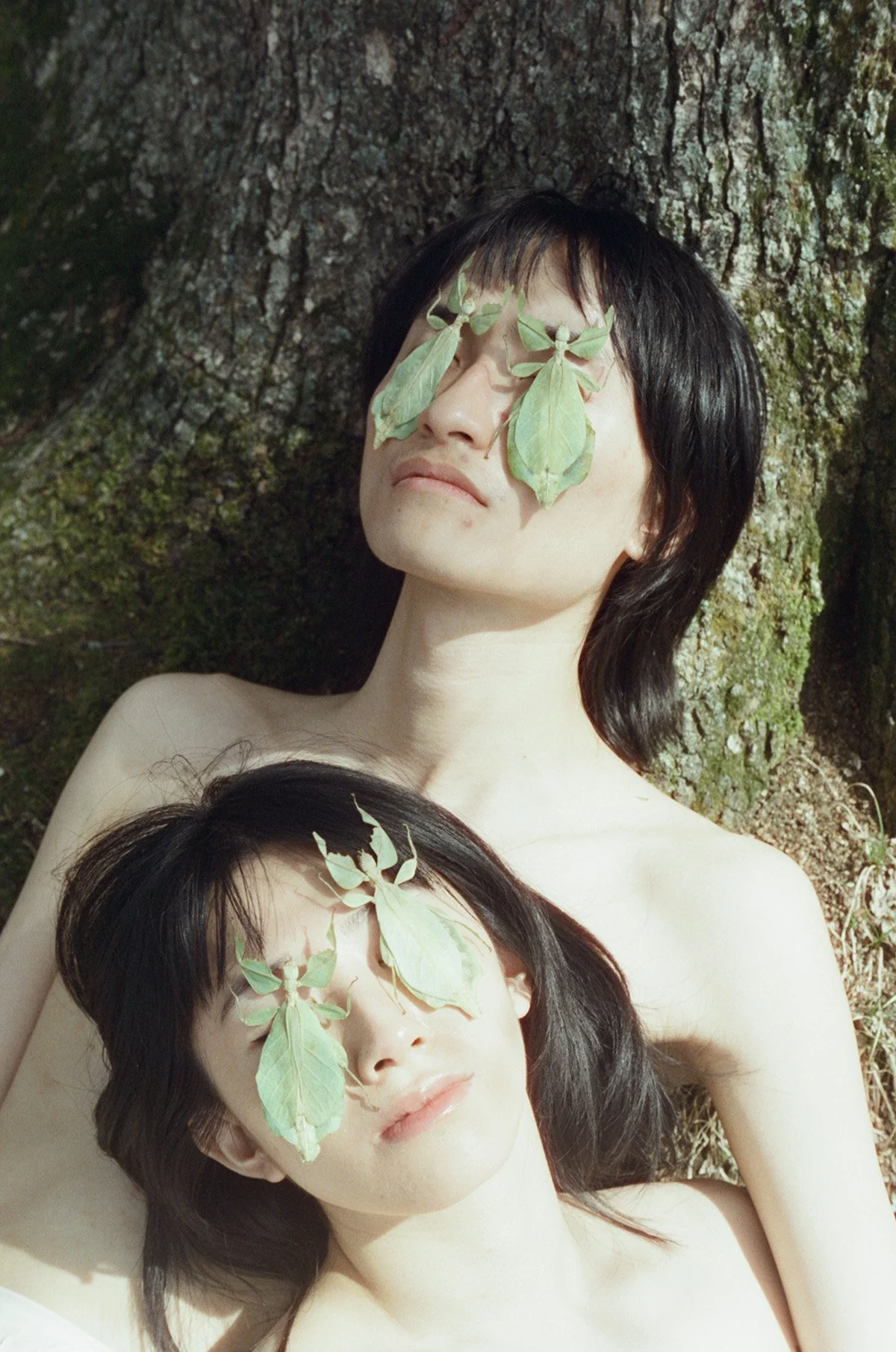
Ancestors (Never Forgive Me, Never Forget Me), 2025
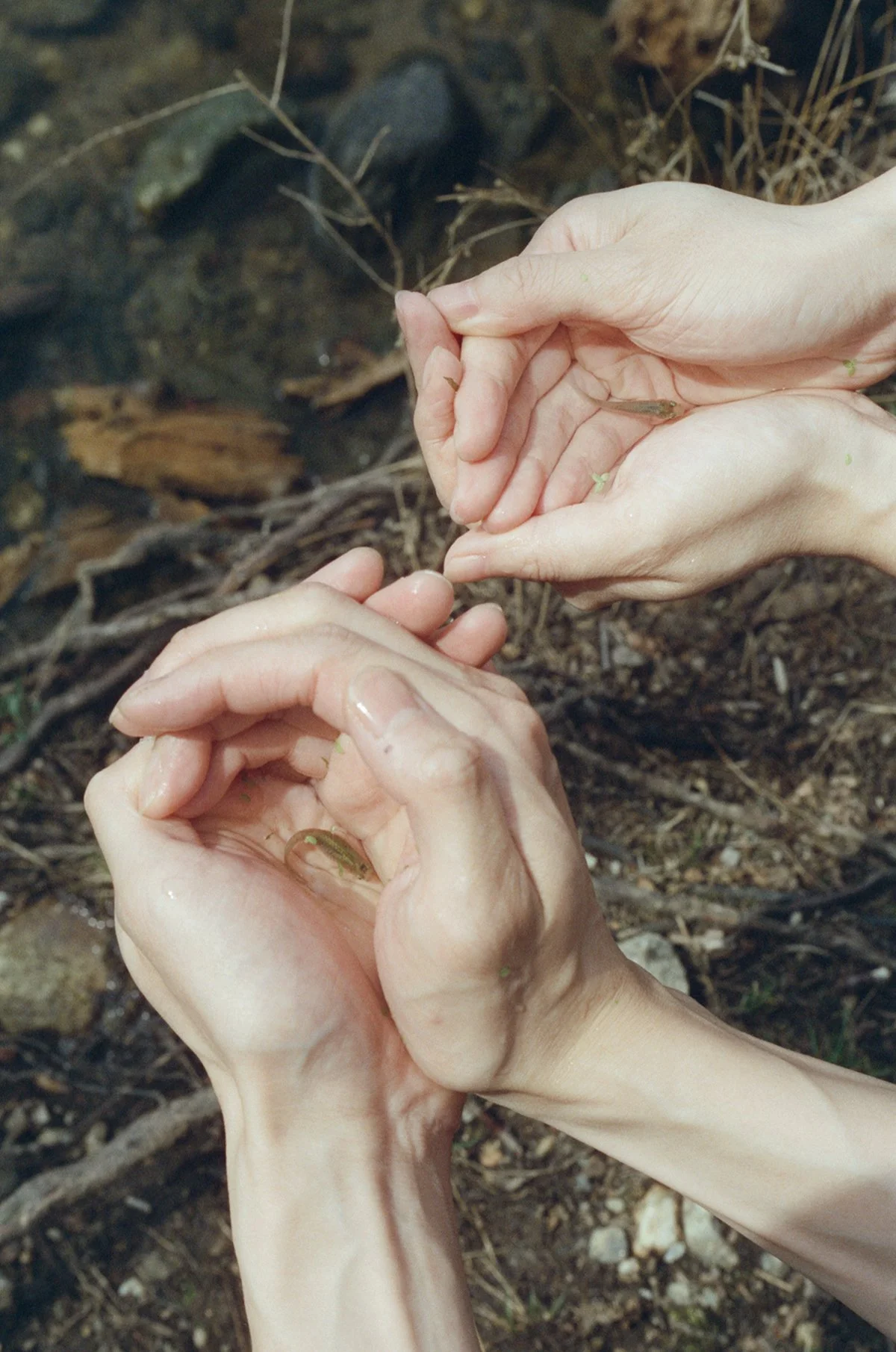
Sanctuary, 2025
Central to your practice is an imagination of the body as a site of haunting, wounding, conjuring, and mythmaking. How does the body hold and communicate these multitudes in your work?
The body is where the material world becomes susceptible to the forces that exceed it: empire, exile, death, biology, and supernatural intervention. It is an active medium through which these forces acquire form.
My paternal family carries a grievance over things stolen from them during China’s Land Reform Movement. My maternal family carries a hereditary predisposition to heart disease and stroke. China conjures its emperors, empresses, war, and dynastic collapse through costume dramas. The empire dies historically, but it continues searching for bodies in which to reappear.
The bodies in my photographs are incarnations of the lost worlds I conjure. They become sites of visitation: Nick, my late friend and former lover, appears in the way I relate to the people I photograph. In The Day of Night, I asked Victoria, my sitter and fellow ritualist, to let Nick’s shirt drift in the lake at twilight. I tied red strings between the sleeve and her wrist.
You’ve described your recent project Conjured Murmurs as a practice of ritual contacts with a late friend and former lover across the seam of time. How did you first start making this work?
Conjured Murmurs was first the title of my Substack, created a year before Nick’s death. I was writing short memoirs about people I loved but could no longer reach. Ordinary contact had ended, but they kept generating new meaning in language.
My photography series of the same name began right after Nick’s funeral, in 2024. We promised each other a lifelong friendship. I continue to contact him and receive him in rituals and photographs, forms that no longer require his body.
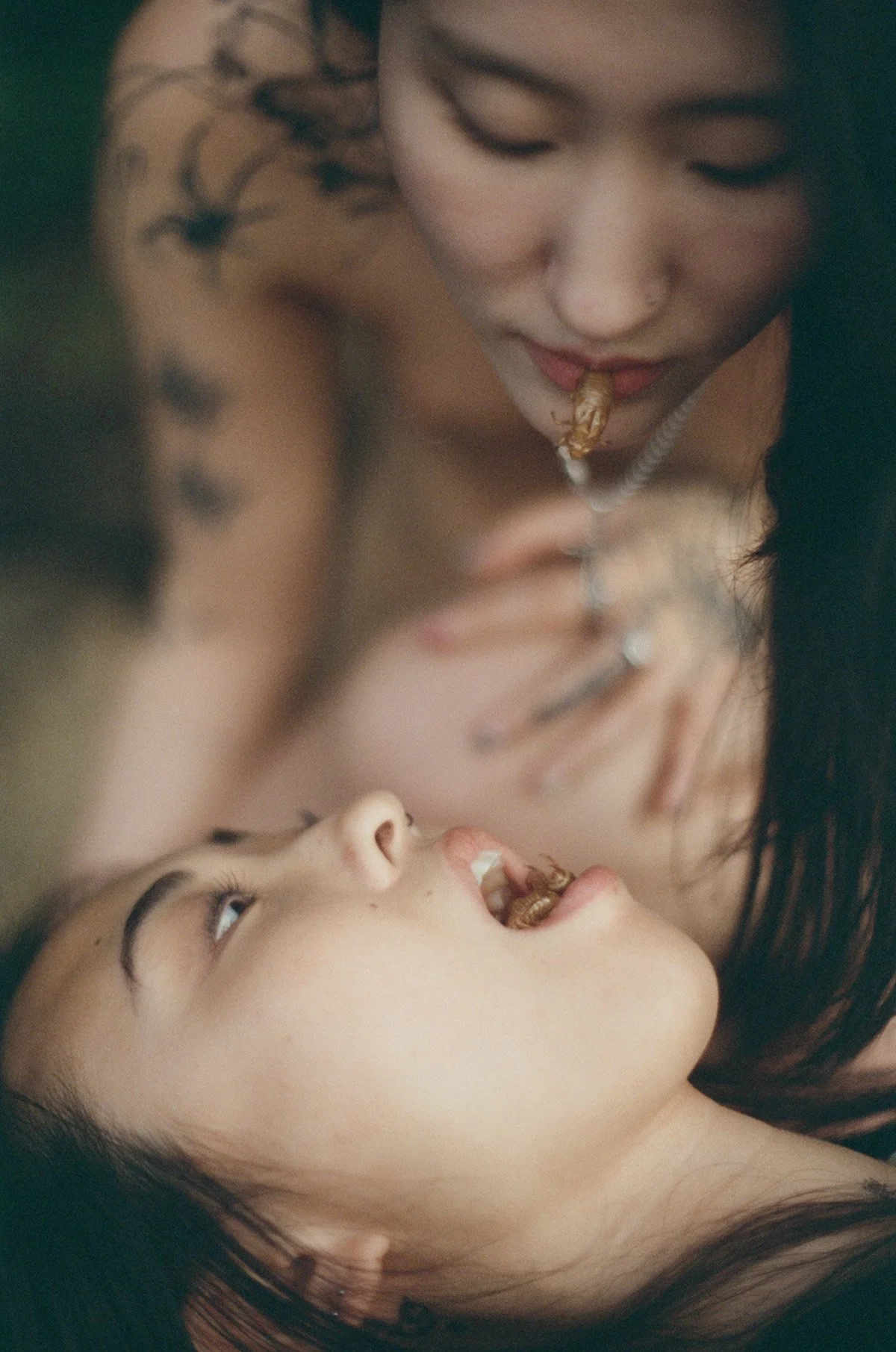
Transference, 2025
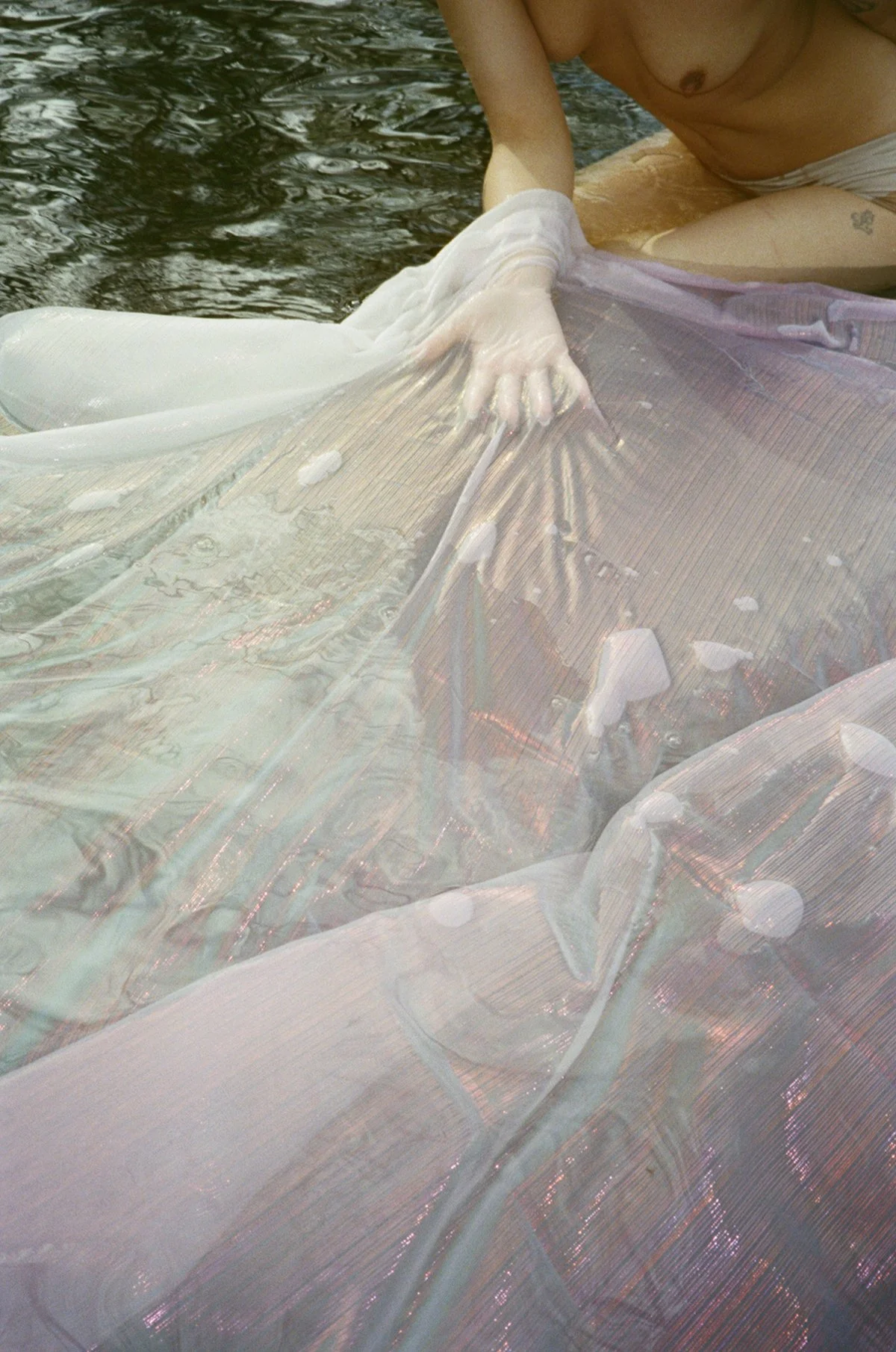
Holy Place, 2025
Conjured Murmurs places the body in dialogue with small creatures, ceremonial objects, and natural landscapes, producing fantasy-tinged and ritualistic scenes. Can you speak to the significance of these symbols and their conversation in the frame?
Conjured Murmurs is a cosmology of death and eroticism. Small creatures, ceremonial objects, and landscapes are participants in it, not symbols. I find sentience itself erotic. What goes on in the inner lives of grasshoppers, cicadas, and millipedes? What do they know that we don’t? What have objects and landscapes witnessed before us, and what will they witness after we die?
In Transference, two women hold cicada shells in their mouths, husks of a metamorphosis already complete. In Han-dynasty burials, a jade cicada was placed on the tongue of the dead. Here the shells sit in living mouths, and whether they are offered, received, or swallowed stays open.
I identify with insects’ smallness. There’s dignity in being a tiny, vulnerable life in an immeasurably large universe. History demands that a life be monumental to matter. Smallness frees me from the obligation of monumentality. In my cosmology, I’m no different from a millipede.
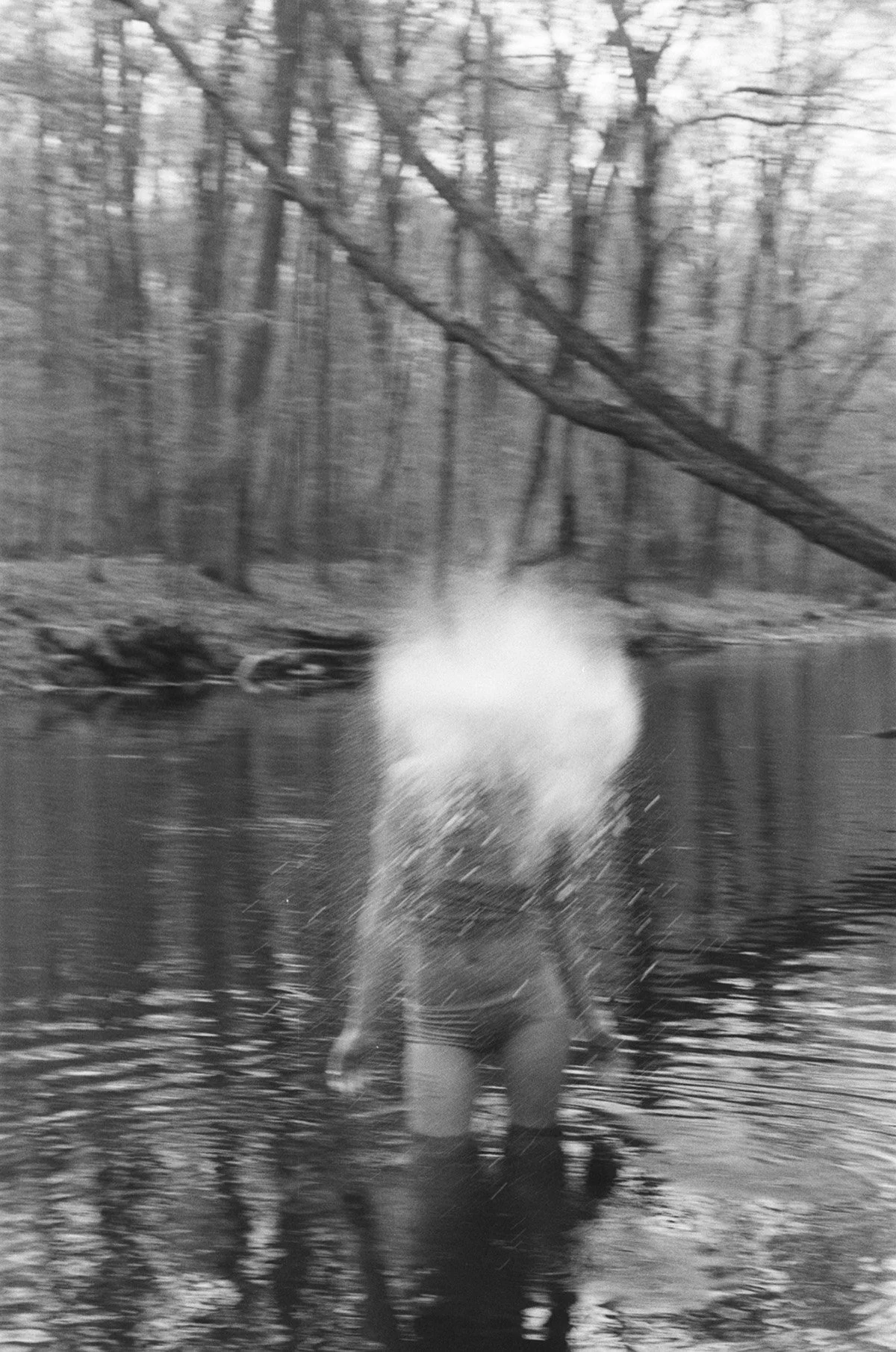
Dissolution, 2025
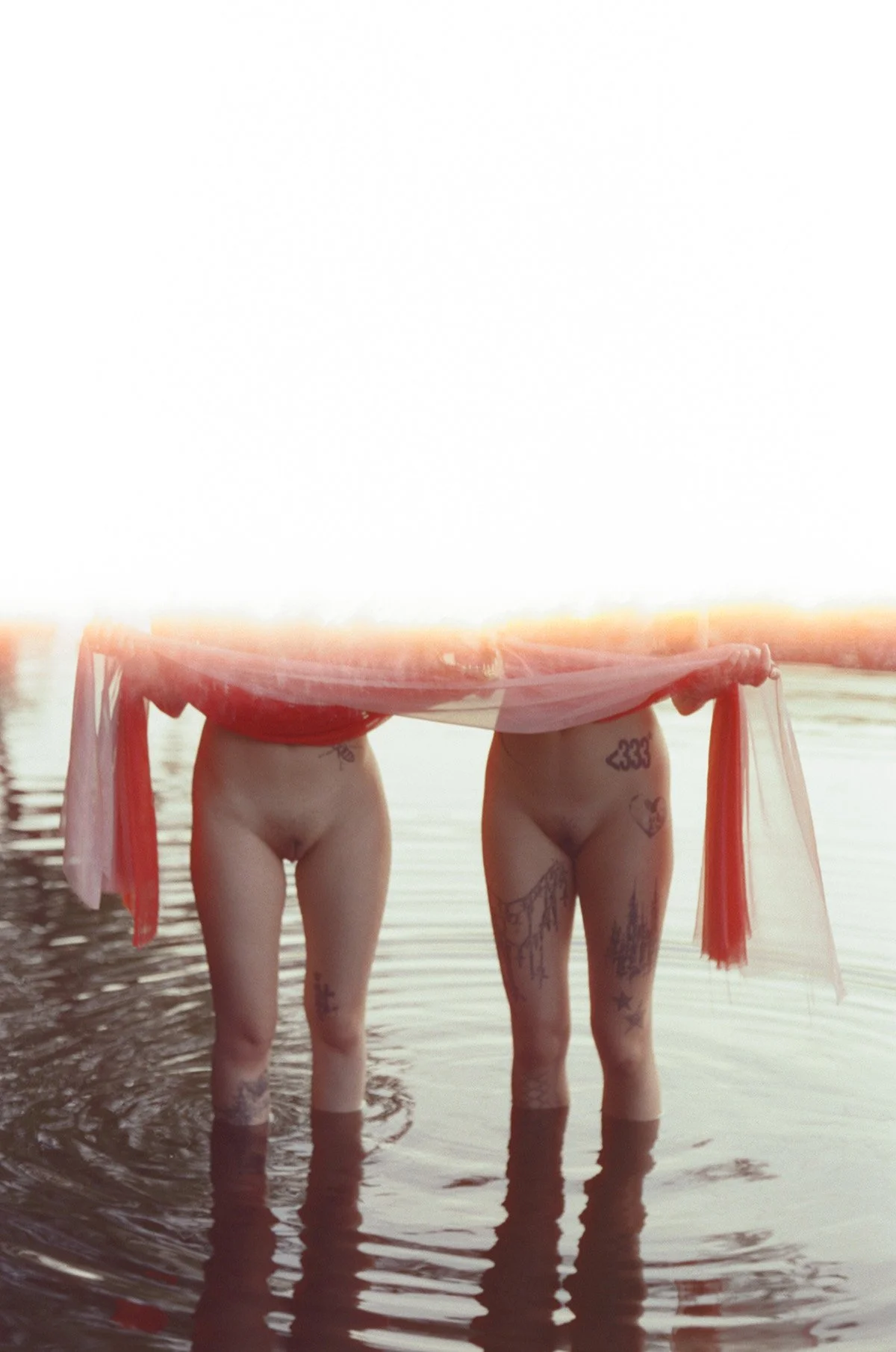
Blank Burial, 2025
You’ve mentioned how the camera acts as a “conjuring apparatus”— what does it bring into being? Does the conjuring occur through the active process of capturing moments or in the resulting image itself?
Photographs are the oracle bones of the modern age. In Shang-dynasty China, diviners put questions to the ancestors by applying heat to bone until it cracked; the cracks were read as replies from invisible realms. The camera does not record rituals; it creates conditions for rituals to take place. The image is where the invisible replies.
I build each encounter for what exposure, flash, and framing can do to it. In Dissolution, a burst of salt engulfs the head of a figure standing in water. The exposure arrests the dispersal as a new, unstable anatomy, so the body is least recognizable at the instant it is most fully photographed. In Blank Burial, two figures vanish above the waist into white light at the beginning of a film roll. The image becomes evidence of an encounter that it also erases.
A photograph does not just recall a moment that has died. A photograph can be made to the dead. I cannot bring Nick back to the material world, but I can make visible the reality shaped by his death.
“The camera does not record rituals; it creates conditions for rituals to take place. The image is where the invisible replies.”
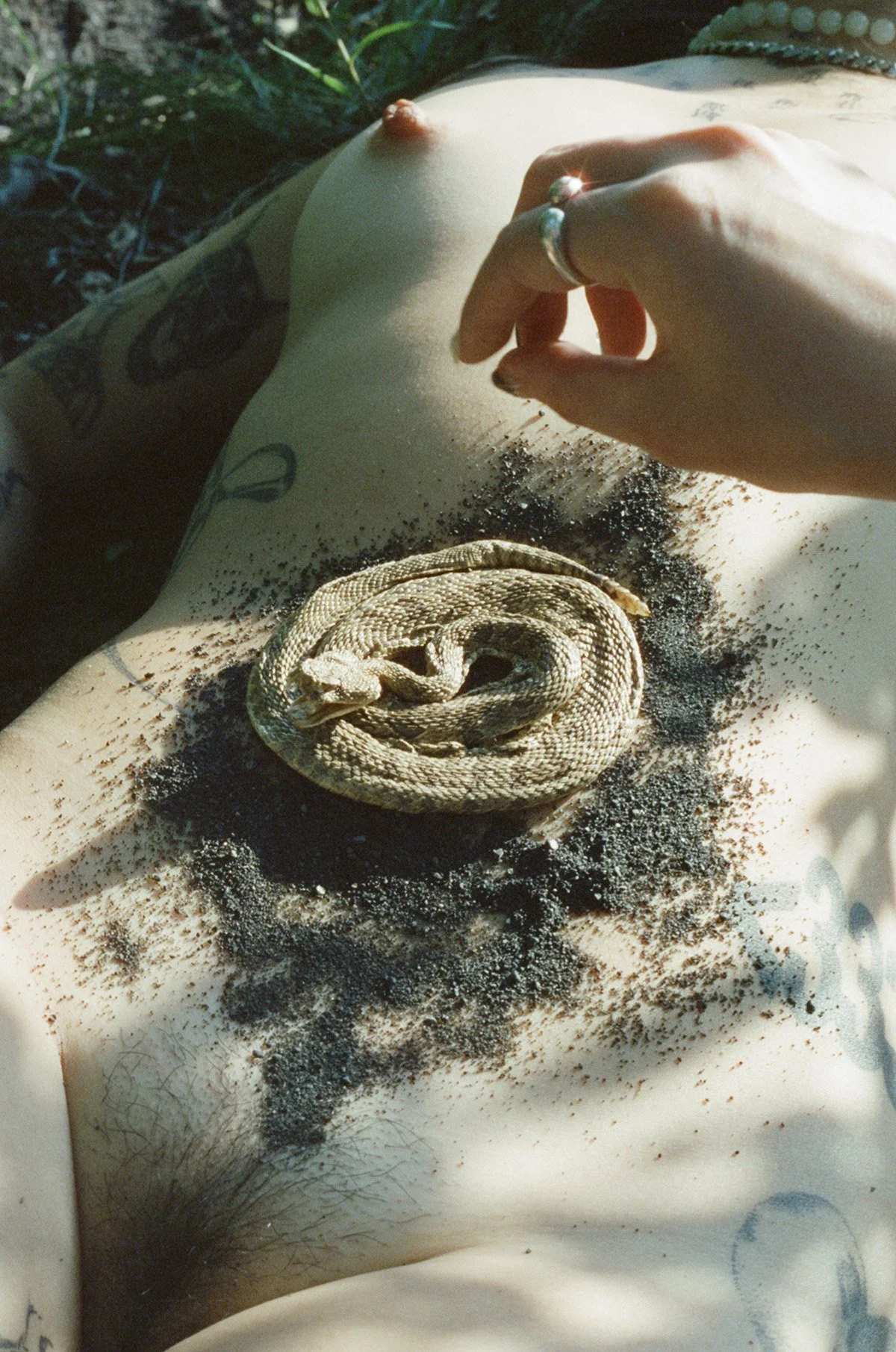
Overheated Fate, 2025
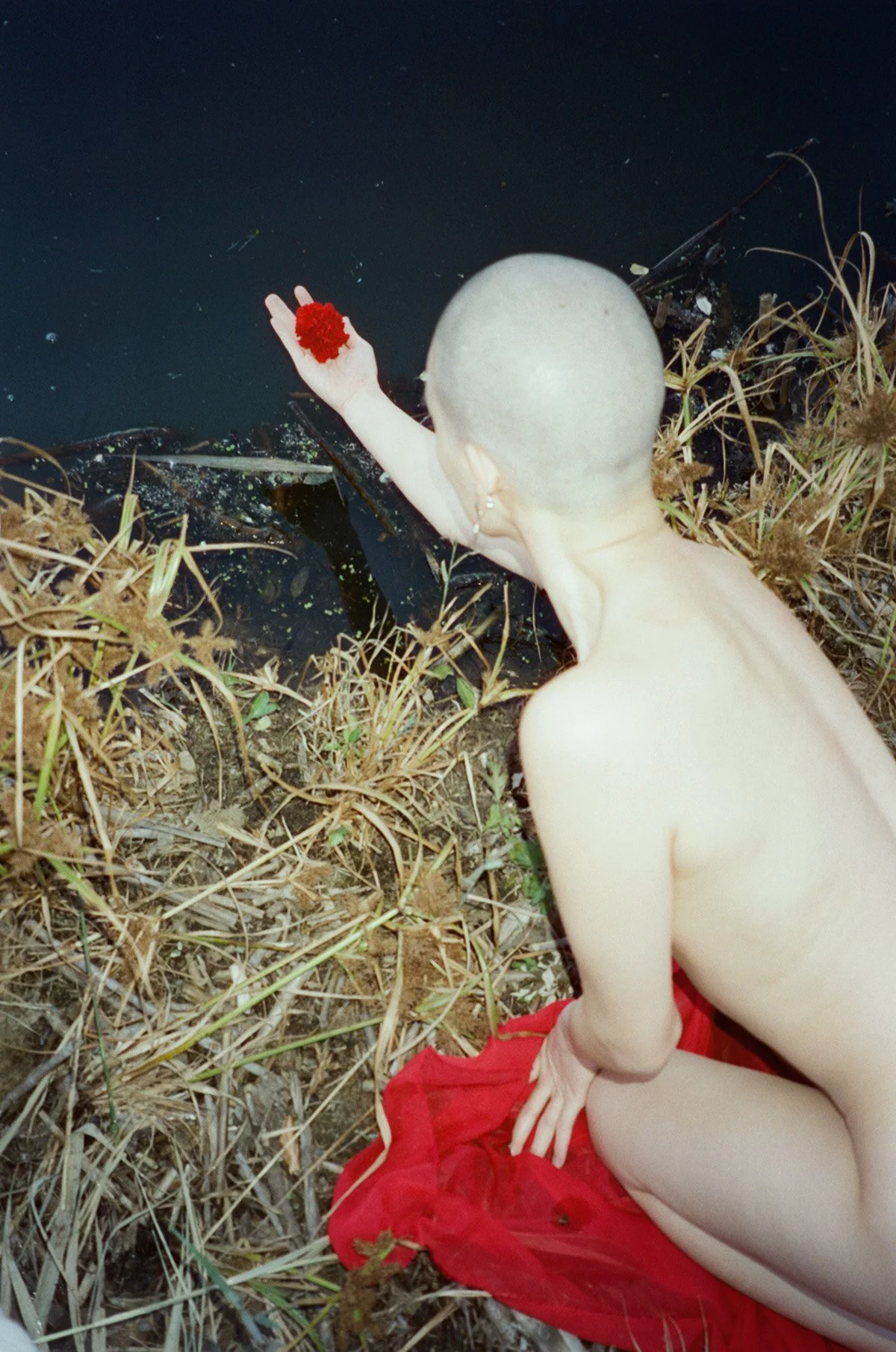
Farewell, 2024
Much of your visual work is paired with reflective writing. Does one mode of expression follow the other? How do these mediums co-exist in your work?
My writing and my visual work are incestuous siblings. They are autonomous, but occasionally they couple. My images produce writing on social media: a photograph of a labradorite held in the palms of my mother and my aunt unfolded into a piece about my grief held by the Loess Plateau, and how the landscape is indifferent to my New York accomplishments.
Some of my images take their titles and concepts from my writing. In August 2025 I wrote an essay called “Overheated Fate,” about a girl I became attracted to at a wedding. She had named her dog Laika, after the stray the Soviet Union sent into space, who died of overheating. I was moved by the girl and by the sacrifice, solitude, and sadness Laika embodied. Shortly after, I named a photograph Overheated Fate. In it, volcanic sand and a rattlesnake lie on the abdomen of my fellow ritualist Fiona. Nick brought me the sand from an Icelandic beach right before he died.
Earlier this year you taught a course at ICP entitled “Extreme Private Eros: Photography and Diaristic Writing,” exploring how intimate photography and writing can work together to express personal, emotional, and mythical narratives. Did stepping into the role of teacher influence your own practice? And if so how?
My courses came out of my practice. In spring 2027 at ICP, I’m teaching Extreme Private Eros again alongside its sister course, Ghostly Matters: Photography and Rites for the Dead. I’m curious about interpersonal dynamics and how one life can transform another, so teaching becomes fieldwork. Exchanges with my students exhilarate and frustrate me, and our differences expand my understanding of eros and relational ethics. A student once asked me, “Is performativity inherently bad in photography?” I had to answer on the spot: “Performance is bad when it’s hiding something. Performance is good when it strengthens something that is already there.” Teaching has made me put into words decisions I usually make by instinct.
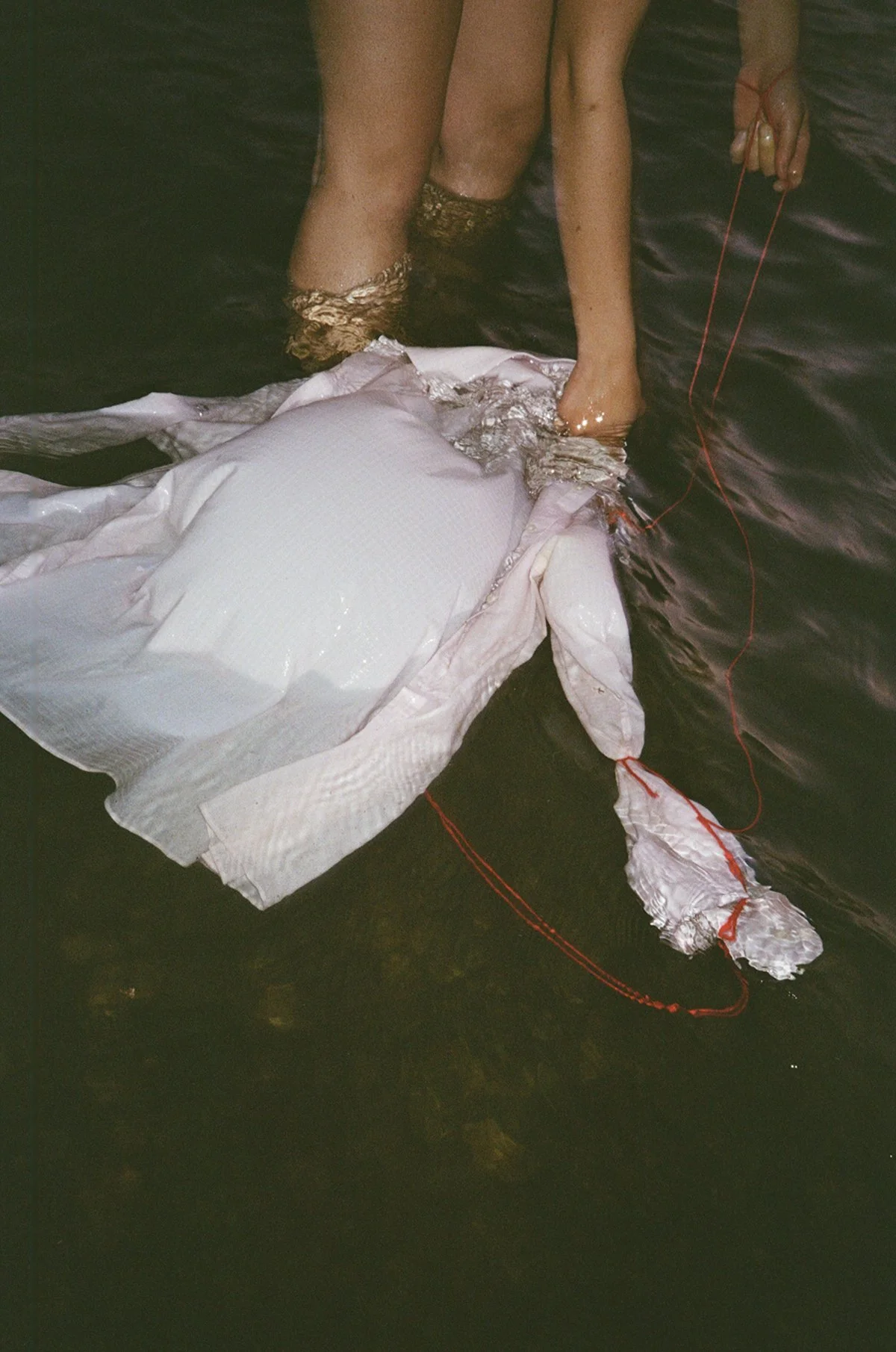
The Day of Night, 2025
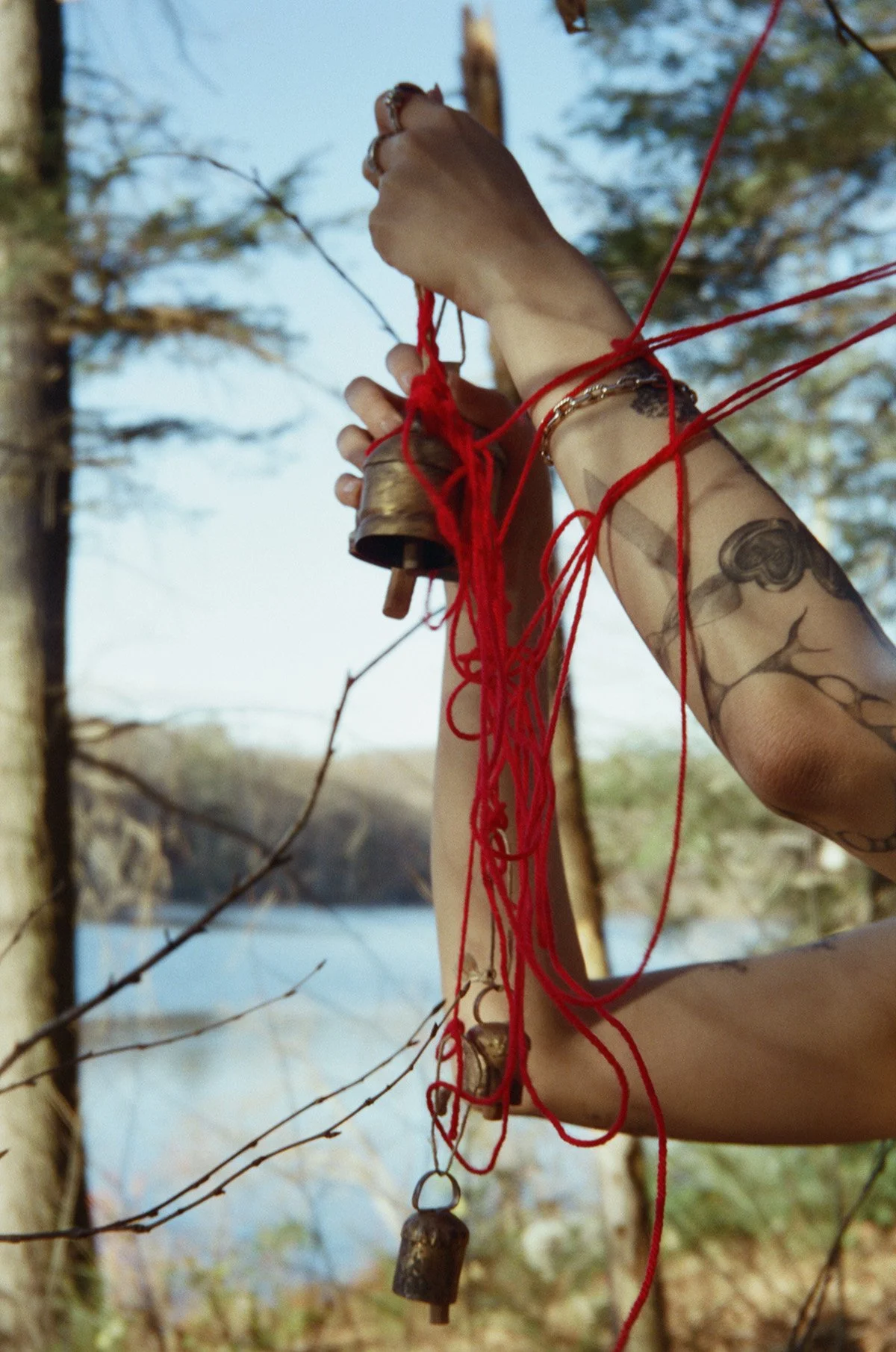
Invisible Ties, 2025
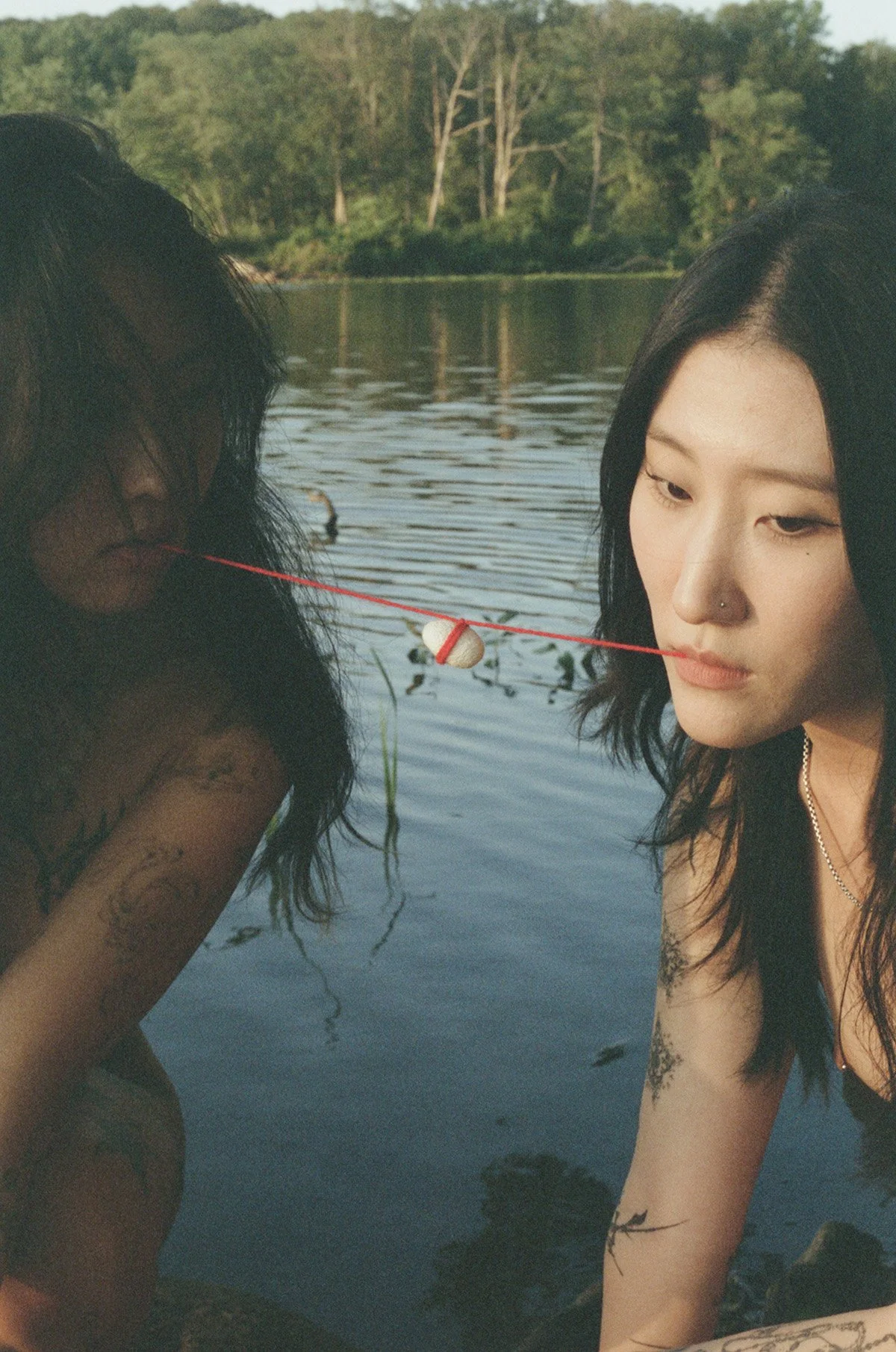
Suspension, 2025
Where is your work heading next? What are you working on at the moment?
I’m back in China, making large-format photo collages, videos, and sculptures that tie together soil erosion, deep time, matrilineage, and imperial Chinese history.
Recently I wrote three pieces about motherhood: “kitten mommy,” “Master Drive,” and “Conductor.” Together they approach three mothers: one sustaining her children, one leaving her child, and one surviving her child. The maternal body holds the not yet born and the already dead. That idea is shaping the new work.
New Voices highlights emerging artists who showcase their unique perspectives and innovative techniques on ArtConnect. Applications are accepted on a rolling basis. If you would like to be featured in a personal interview on ArtConnect Magazine, read through the open call and apply here.